

NDIS Report Template Checklist for Psychologists
Check NDIS psychology report purpose, evidence sources, six functional domains, support needs and recommendations, with an optional editable Word toolkit.
Educational information, not individual clinical, legal or regulatory advice. No independent review is identified for this article. Editorial policy and corrections.
Why clinicians keep searching for a better NDIS report template
Most psychologists do not need another blank document. They need an NDIS report template that helps them think clearly, write faster, and justify recommendations without sounding repetitive or vague.
That is why searches like ndis report template, ndis psychology report example, and functional impact wording keep showing up. The pain point is not just formatting. It is the cognitive load of turning assessment findings into language that is clinically solid and easy for a decision-maker to follow.
A strong template reduces that load. It gives the clinician a structure to work inside, keeps the report anchored to function, and makes it easier to explain why a support matters.
If you build, buy, or sell NDIS report resources, this is the standard worth aiming for.
For the session-by-session documentation that often supports report writing, see how to write psychology progress notes.
For a step-by-step writing process, including report purposes, evidence sources and recommendation examples, read how to write an NDIS psychology report. This checklist focuses on choosing and reviewing the structure rather than replacing that clinical work.
What a strong NDIS psychology report needs to achieve
If you are preparing evidence while the planning approach develops, see new NDIS framework planning: what psychology reports should explain. Clear documentation can describe support needs without treating consultation proposals as final rules or promising a budget outcome.
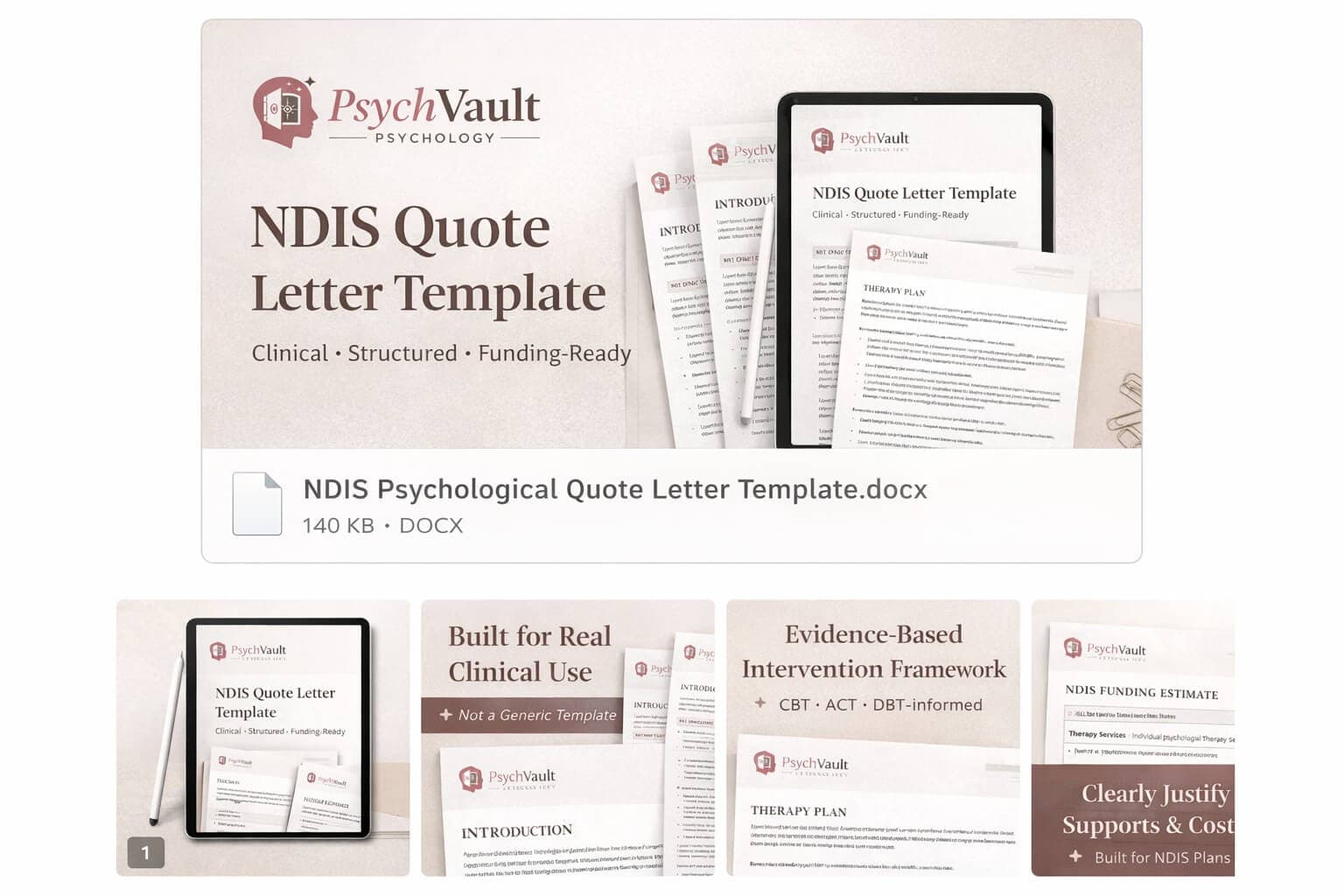
The most useful templates help the clinician answer five questions in a logical order:
- 1Why was this report requested?
- 2What is happening functionally in everyday life?
- 3How do the current barriers affect participation, independence, or stability?
- 4What support is being recommended?
- 5Why is that recommendation reasonable and necessary?
That sounds obvious, but many reports drift too heavily into background narrative, diagnosis summaries, or long descriptive sections without translating the material into functional reasoning.
An NDIS report becomes stronger the moment the reader can move cleanly from concern to impact to recommendation.
Choose the report purpose before choosing a template
The NDIA guide to report writing distinguishes reporting tasks. Check the purpose before reviewing a template:
| Purpose | What to check in the structure |
|---|---|
| Access evidence | Evidence relevant to access, including impairment, everyday activities, assistance and information sources. A diagnosis alone does not describe functioning. |
| Needs assessment or functional capacity report | Current functioning, existing assistance, unmet need and individualised recommendations within the clinician's scope. |
| Progress or plan reassessment report | Supports delivered, progress towards goals, outcomes, barriers and recommendations for future support. |
| Early childhood reporting | Development, participation, family priorities and outcomes. Use the NDIA early childhood reporting guidance for children younger than nine, including its official template where appropriate. |
What should an NDIS psychology report include?
Adapt the structure to the purpose rather than completing every heading mechanically:
- 1Participant details, report purpose, reporting period and accurate author credentials.
- 2Consent, information sources, dates, informants and assessment limitations.
- 3Relevant background, strengths, preferences and existing supports.
- 4Functional impact, assistance required and gaps in available support.
- 5Assessment findings and interpretation, keeping test scores separate from funding decisions.
- 6For progress reports, supports delivered, outcomes, barriers and participant perspectives.
- 7Individualised recommendations with evidence, intended outcomes and review points.
- 8Any requested cost estimate, accurate sign-off and agreed distribution.
Functional impact describes difficulties in everyday activities. Support needs describe the assistance required and how often. Unmet need describes the gap where assistance is unavailable, insufficient or unsustainable. Keep these separate so a reader can follow the reasoning.
Check the six functional domains where relevant
The NDIA supporting-evidence guidance identifies mobility, communication, social interaction, self-care, self-management and learning. Describe relevant tasks, assistance and frequency, distinguishing observed, assessed and reported information.
These domains inform access evidence. They do not require a full six-domain assessment in every progress report or assessment beyond your competence. State limitations and seek other professional input where needed.
A practical checklist for a better template
1. Make the opening paragraph do real work
The first paragraph should tell the reader who the report is for, why it exists, and what decision it is meant to inform.
A weak opener feels administrative. A strong opener reduces uncertainty immediately.
Good opening paragraphs usually clarify:
- who requested the report
- what support question is being considered
- what assessment or review context applies
- what timeframe or planning context matters
2. Separate background from functional evidence
Background history matters, but it should not overpower the report. Templates work best when they clearly separate "context" from "current functional consequences".
That helps stop the common problem where the reader gets a lot of history but still does not understand what daily life currently looks like.
3. Prompt for functional examples, not abstract wording
This is where many templates fail. Instead of asking the clinician to write a broad narrative, the template should actively prompt for concrete examples across areas like:
- planning and organisation
- self-care and daily living tasks
- emotional regulation
- community access
- sensory load and recovery
- social participation
- study or work functioning
The more observable the example, the stronger the report usually reads.
If a recommendation is not clearly linked to function, it can sound like preference rather than clinical necessity.
4. Make recommendation sections impossible to keep vague
A good recommendation section should prompt the writer to include:
- the support being recommended
- the barrier it addresses
- the functional outcome it is intended to support
- what is likely to happen if support is delayed, reduced, or not provided
This protects the report from turning into a shopping list of supports with no clinical bridge between the problem and the recommendation.
The companion guide to reasonable and necessary NDIS funding criteria explains the policy reasoning that should connect each recommendation with disability-related function, goals, effectiveness, value, and the appropriate funding system.
5. Build in a short quality-control pass
The best templates help after the report is drafted too. Include a final checklist such as:
- 1Is every recommendation linked to a functional issue?
- 2Are the examples concrete rather than generic?
- 3Does the report over-explain history and under-explain current impact?
- 4Could a reader skim the headings and still follow the logic?
- 5Does the wording sound case-specific rather than copied?
This kind of check saves time because it catches the most common weaknesses before the report leaves your desk.
What better functional wording sounds like
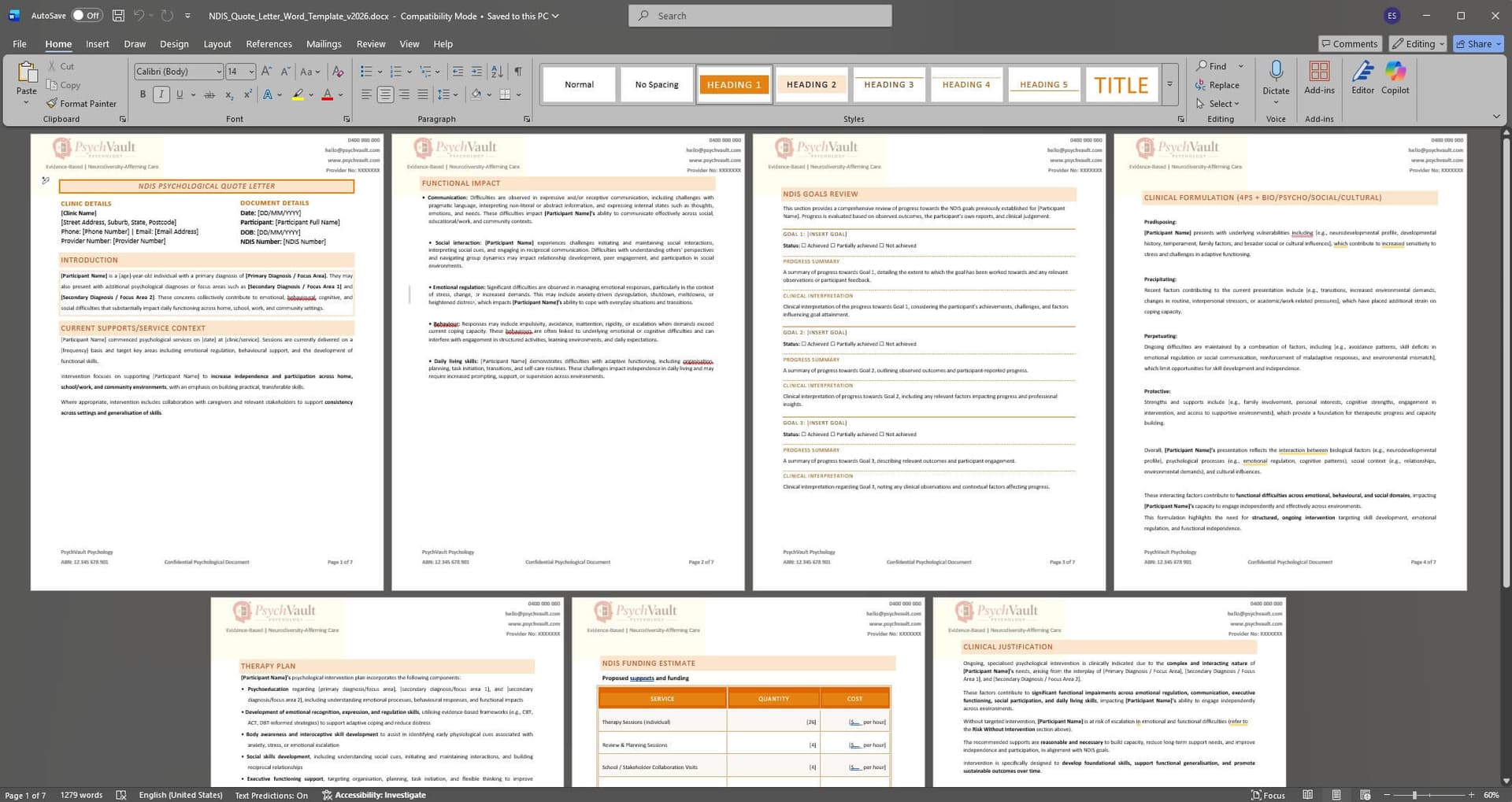
Templates are most useful when they push the clinician toward cleaner language. In practice, that often means replacing soft abstractions with more grounded statements.
Less helpful wording:
- "has significant difficulty with daily tasks"
- "struggles socially"
- "finds regulation hard"
Stronger wording:
- "requires repeated prompting to begin and complete routine daily tasks"
- "has difficulty interpreting social cues in unfamiliar settings, which limits participation and increases withdrawal"
- "becomes dysregulated after unexpected change and may need extended recovery time before re-engaging with daily demands"
You do not need to make the writing dramatic. You need to make it specific.
Common template mistakes that slow clinicians down
Mistake 1: treating the template like the finished report
A template is a scaffold, not the final clinical product. If it includes too much pre-written prose, the document can start to sound generic very quickly.
Mistake 2: asking for too much in one section
When a heading tries to cover history, formulation, impact, and recommendations all at once, the result usually becomes muddled. Cleaner segmentation usually leads to faster writing.
Mistake 3: overusing diagnostic wording
Decision-makers generally need to understand how the presentation affects daily life. Diagnostic language may be relevant, but it should support the functional picture, not replace it.
Mistake 4: skipping the "what happens without support" question
When appropriate, this section gives weight to the recommendation. It helps show why the support matters in practice rather than sounding optional.
When to review and update your template
An NDIS report template is not a set-and-forget document. It is worth reviewing yours when:
The October 2026 Improved Daily Living funding changes are one example of why current policy settings, support categories, and implementation guidance need to be checked before a report is finalised.
Before recommending psychology, also check the current distinction between clinical treatment and disability-related functional capacity building in Does the NDIS Still Fund Psychology in 2026?. A report should describe the actual purpose of the support, not rely on a support-item label alone.
- NDIS policy or planning guidelines change
- You notice a recurring pattern of reviewer feedback on your reports
- You start working with a new population where your existing structure does not quite fit
- A colleague reviews your report and has trouble following the logic
Even small updates — tightening a functional wording prompt, reordering two sections, clarifying a recommendation scaffold — can make a meaningful difference to writing speed and report quality over time.
If you work in a practice with other clinicians, aligning on a shared template is usually worth the effort. It improves consistency across the team and makes peer review easier when reports need a second read before going out.
More NDIS resources
You can also browse the broader NDIS resources collection. Editorial inclusion here is selective and does not replace your own clinical or regulatory review.
Frequently asked questions
What should an NDIS psychology report include?
Start with the report purpose, sources and limitations, then describe relevant functional evidence and individualised recommendations. A progress report, access-evidence document and needs assessment answer different questions; use the purpose table above.
How long should an NDIS functional capacity assessment report be?
Length varies by complexity of the presentation. Most functional capacity assessment reports are 4–12 pages. The priority is functional specificity and a clear, evidenced link between the client's presentation and the supports recommended, not word count. Longer reports are not automatically stronger.
What is the difference between an NDIS functional capacity assessment and a general psychological assessment report?
A functional capacity assessment focuses on how a person's disability affects their ability to perform daily activities and participate in community life. It informs NDIS planning directly. A general psychological assessment report covers diagnosis, cognitive and emotional functioning, and clinical recommendations more broadly. The two can overlap, but they serve different primary purposes. NDIS planners generally need functional specificity, not a full neuropsychological write-up.
Can a provisional psychologist write NDIS reports?
Work within your competence and supervision arrangements. Agree with your supervisor how the report will be reviewed and signed, state registration status accurately, and confirm any provider or organisational requirements. Do not assume one sign-off rule covers every reporting context.
How often should NDIS reports be reviewed or updated?
NDIS plan reviews typically occur annually, and supporting reports should be current. A report older than 12–24 months may not adequately reflect the client's current functional status and may be queried at plan review. Update reports whenever functional capacity has changed materially or when the client's plan is up for review.
Final takeaway
The best NDIS report templates do more than save time. They improve the quality of reasoning, sharpen the link between function and recommendation, and make it easier to produce consistent reports under real clinical pressure.
If your current workflow still feels heavy, the answer is usually not "write more". It is "start from a structure that does more of the thinking with you".
See also: Therapist Resources: clinical documentation, NDIS guides, and psychology templates →
Discussion
Share your thoughts and experiences with this resource.
Sign in to leave a comment
Comments
Therapist Resources for Australian Clinicians
Continue with the complete therapist resources for australian clinicians collection.
Browse Therapy Worksheets
Find templates, handouts, and clinical tools created for use in real psychology and allied health work.
Continue exploring Therapist Resources for Australian Clinicians

A practical guide for psychologists writing NDIS reports, with a clear structure, functional-impact examples, recommendation prompts and an editable Word template.

The NDIS still funds some psychology supports in 2026. Learn the difference between disability-related functional capacity building, clinical treatment, assessments, reports and pricing.

From October 2026, Improved Daily Living Skills budget allocations will be reduced by 10%. Learn when the reset applies, what is exempt and what to do next.