
Practical psychology templates for therapy, assessment, and NDIS work
Find and assess free or downloadable psychology templates for therapy, intake, case formulation, behaviour support, progress notes, and NDIS documentation.
Educational information, not individual clinical, legal or regulatory advice. No independent review is identified for this article. Editorial policy and corrections.
Why templates matter in clinical practice
Most clinicians, students, and practitioners spend far more time than they should rebuilding the same documents.
Progress notes. Intake forms. Worksheets. NDIS reports.
Good templates reduce that friction without replacing clinical thinking. They give you a structure to work inside, prompt you toward the information that matters, and make it easier to produce consistent, high-quality work under real time pressure.
The best psychology templates do not just save time. They improve the quality and consistency of what gets documented, communicated, and shared with clients.
For the broader task of choosing psychology resources for Australian practice, including handouts, reports, assessments, and local service context, start with the resource-discovery guide.
What are psychology templates?

Psychology templates are structured documents that support common mental health workflows. Depending on the context, they might be:
- client-facing worksheets completed in or between sessions
- practitioner-facing tools used during assessment or formulation
- documentation scaffolds for reports, notes, or plans
- psychoeducation handouts that explain concepts in plain language
The common thread is structure. A strong template makes it easier to think clearly, not just faster to write.
For deeper guidance on specific template types, see the progress notes guide, the NDIS report template checklist, and the psychoeducation handouts guide.
Free psychology templates you can use right now
If you want to browse immediately, start with resources on PsychVault, psychoeducation handouts, or therapy worksheets. Filter by price on the browse page to find free items.
One useful resource already on the site is psychoeducation handouts: free, neurodiversity-affirming handouts worth reviewing if you work with autistic clients or their families.
Below are the templates used most consistently across clinical, educational, and NDIS contexts.
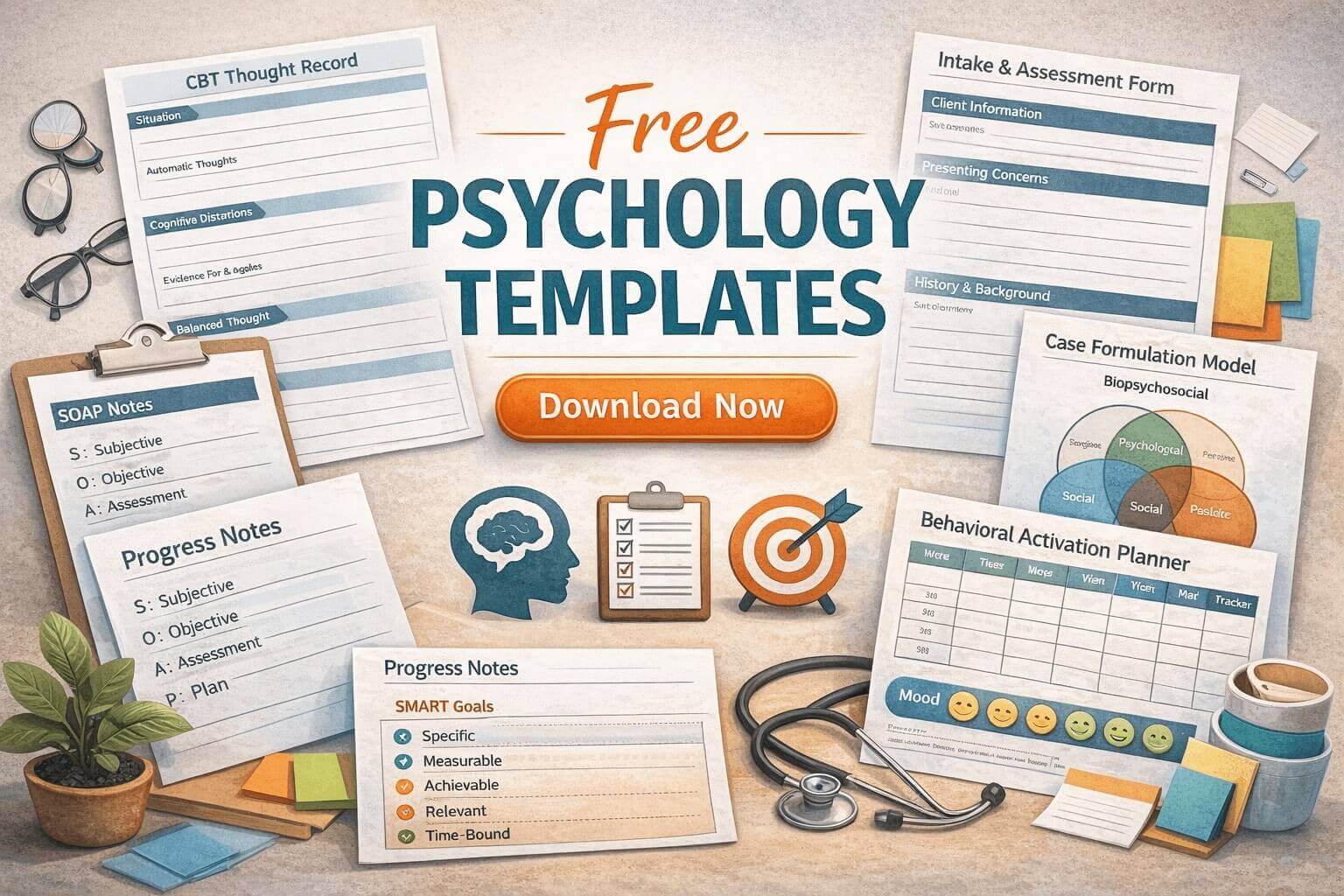
CBT Thought Record Worksheet
Best for: Anxiety, depression, cognitive restructuring
The thought record is one of the most widely used tools in CBT. It helps clients notice and examine their automatic thoughts in response to specific situations, then work toward a more balanced or realistic perspective.
A strong thought record includes:
- A clear situation prompt, where, when, who was present
- Space to capture the emotion and its intensity
- The automatic thought itself, written as specifically as possible
- Evidence that supports and challenges the thought
- A balanced thought to end with, along with a revised emotion rating
The value of this worksheet comes from completing it close to the activating situation, ideally within a few hours, when the thought is still accessible. Between-session completion is often more useful than in-session work alone for this reason.
Intake and Initial Assessment Template
Best for: First sessions and structured clinical interviewing
A well-designed intake template gives an initial session structure without making it feel like a form-filling exercise. The goal is to capture the information you need while preserving room for the conversation to go where it needs to.
A reliable intake template covers:
- Presenting concerns in the client's own words
- Relevant background and history
- Current supports and prior treatment
- Risk and safety screening
- Initial goals and expectations
Templates that work well in this context tend to be prompt-based rather than prescriptive. They give the clinician reminders, not scripts. This matters especially for practitioners who want to work conversationally without losing the structure required for thorough assessment.
Case Formulation Template (Biopsychosocial)
Best for: Integrating assessment findings into a coherent clinical picture
A biopsychosocial formulation helps bridge the gap between assessment and treatment. It gives the clinician a way to organise a complex presentation into something that can be understood, communicated, and updated over time.
The four-factor structure most clinicians use:
- Predisposing factors: vulnerabilities present before the current presentation
- Precipitating factors: what triggered or worsened the current difficulties
- Perpetuating factors: what is maintaining the problem now
- Protective factors: existing strengths, supports, and resilience
Strong formulation templates prompt the clinician to populate each section briefly with observable, case-specific evidence, not generic labels. A formulation that could apply to anyone is rarely useful for planning treatment for a specific person.
Behavioural Activation Planner
Best for: Depression, low motivation, withdrawal
Behavioural activation works by helping clients re-engage with activities that carry meaning, pleasure, or a sense of achievement, even when motivation is low. The planner is the practical tool that makes this concrete.
Useful components:
- A weekly activity schedule with prompts for morning, afternoon, and evening
- A mood or energy rating alongside each activity
- Space to note which activities felt worthwhile or meaningful
- Prompts connecting activities to the client's own values or priorities
The key to using this template well is collaborating with the client on what goes in it. Activities chosen by the client — however small — are far more likely to be completed than activities prescribed by a clinician who does not yet know what matters to them.
Behavioural Escalation Profile
Best for: Behaviour support, NDIS contexts, complex needs
An escalation profile maps what a person's behaviour looks like at different levels of distress: from their calm baseline through to peak distress and into recovery. It is particularly useful in NDIS and school settings where multiple support people need a shared, practical reference.
The most useful profiles capture:
- Observable indicators at each escalation stage, not inferences
- Known triggers and early warning signs
- What helps at each stage, from the person's perspective where possible
- What typically prolongs escalation or delays recovery
- A clear description of the recovery phase and what it needs
A well-built escalation profile reduces inconsistency across support staff. When everyone responds in a similar way to the same signals, de-escalation tends to be faster and less distressing for the person involved.
For related resources, browse NDIS resources and the currently available psychology resource library.
Goal Setting Worksheet (SMART Goals)
Best for: Therapy planning, NDIS reporting, school settings
Goal-setting worksheets help clients move from vague intentions to specific commitments. In clinical and NDIS contexts, they also serve a documentation function: giving practitioners something clear to review at subsequent sessions or planning meetings.
A practical goal-setting template includes:
- Space to articulate the goal in the client's own language, before translating it into SMART language
- Prompts for the specific, measurable, and timebound dimensions
- A short section on what might get in the way, and what would help
- A check-in structure for reviewing progress at the next appointment
The SMART framework works best when it is treated as a translation tool rather than a constraint. Start with what the client actually wants, then refine the language together.
You can also browse the current resource library and report templates and formulation guides.
How to use templates effectively

Templates are most powerful when used flexibly.
Adapt, do not follow rigidly. A template is a scaffold, not a script. The best ones prompt you toward the right clinical thinking rather than prescribing the exact words you use.
Keep them simple. Overly complex templates often go unused. If filling in the template feels harder than just writing the document from scratch, the template needs trimming.
Match the client. Adjust language and structure depending on age, neurotype, literacy level, and cultural context. A worksheet designed for one population often needs modification before it works well with another.
Use them collaboratively where appropriate. Worksheets and planners tend to work better when completed with the client rather than for them. Shared completion creates engagement and gives the clinician real-time insight into how the client understands the task.
What makes a strong psychology template?
A well-designed template is usually:
- clear within seconds: the purpose is obvious before reading closely
- structured around what the clinician or client actually needs to know
- brief enough to be used consistently under clinical time pressure
- specific enough to generate useful, case-relevant content
- designed so it still looks clean and professional when printed or shared as a PDF
If a template feels confusing to complete, it rarely improves with more use. The friction is usually a design problem, not a user problem.
Where to find more templates
If you want to keep browsing, start with:
Discussion
Share your thoughts and experiences with this resource.
Sign in to leave a comment
Comments
Therapist Resources for Australian Clinicians
Continue with the complete therapist resources for australian clinicians collection.
Browse Therapy Worksheets
Find templates, handouts, and clinical tools created for use in real psychology and allied health work.
Continue exploring Therapist Resources for Australian Clinicians

A practical guide to creating psychoeducation handouts for Australian practice: clear, credible, and designed for real clinical sessions.

A grounded guide to selling psychology resources with clear scope, useful previews, credible claims, and marketing that does not undermine clinical trust.
A practical guide to efficient psychology session records, including note structure, clinical reasoning, risk, client response, defensibility, and next steps.