

Informal Supports in NDIS Reports: When Family Help Hides Support Needs
Document family help, functional capacity and carer sustainability in NDIS reports, with separate guidance for access evidence and planning.
Educational information, not individual clinical, legal or regulatory advice. No independent review is identified for this article. Editorial policy and corrections.
Scheduled review: 1 February 2027. This is not a completed review date.
Alex attends appointments, eats regular meals and usually remembers to take their medication. On paper, it sounds like daily life is going fairly well.
Their partner tells a fuller story. They book the appointments, check that Alex has seen the reminders and help them get out the door. They plan meals and prompt Alex to start preparing them. On harder days, they do more of the task themselves.
Both accounts can be true. A task getting done tells you very little about who made it happen.
Checked 7 November 2026. This guide covers access and planning reports. The February 2027 planning changes are described separately because they are not yet in force. The examples are fictional.
Access and planning ask different questions
For access, describe the person's capacity in relation to the relevant activity. Section 9B defines this by reference to ability without help, with allowances for aids or modifications that are both commonly used and ordinarily used by the person, and for age-appropriate help for children. Personal and environmental influences are excluded as far as possible. Under section 24(1)(c), the activity is considered as a whole. These amendments apply to relevant decisions from 27 August 2026, including decisions about people already participating. [1][2]
This distinction concerns the functional-capacity part of access assessment. It does not replace the other access requirements. A partner's prompting can help explain why an activity succeeds in everyday life. Record it as assistance rather than counting the supported result as evidence of independent ability. If your conclusion about ability without assistance is inferred, explain what supports the inference and what remains uncertain. The Act allows rules to specify assessment methods under section 9B(2); this article does not prescribe one.
For psychosocial access evidence, the treatment history and permanence guide explains the separate questions about treatment, prognosis and functional capacity.
For planning, describe the help available now and what it is reasonable to expect informal supporters to provide. Where section 34 applies, the decision-maker must consider that question under paragraph (1)(e). Since 27 August 2026, paragraph (1)(aa) also requires the proposed support to address a need arising directly from an impairment for which the participant meets the disability or early intervention requirements. Name that connection rather than assuming that every difficulty described in the report arises from the same impairment. [1][2]
Rule 3.4 of the Supports for Participants Rules already requires consideration of informal support. For children, it addresses additional disability-related care and risks to carers. For other participants, it considers suitability, carer capacity, long-term wellbeing and effects on the participant’s independence. Developing informal networks is also a consideration. These factors should be documented where relevant; a particular phrase or completed table does not establish that the funding criteria are met. [3]
Who notices, who starts, and who finishes?

“Family helps with daily living” could mean one reminder a week, repeated prompts most mornings, or someone taking over a task entirely.
Start with a specific activity. Who notices it needs doing? Who starts it? Which steps does the person manage? What happens when they get stuck or the usual help is unavailable?
Alex reports being able to prepare a familiar simple meal once ingredients have been selected and laid out. Their partner reports initiating meal choice, gathering ingredients and giving repeated prompts to start on most weeknights. Alex reports eating packaged snacks or toast on three nights during a week when their partner worked evenings. Meal preparation was not directly observed. The partner reports that the arrangement is manageable with predictable work hours but becomes difficult when work demands increase or their own energy is lower.
This fictional example separates reported ability, assistance and sustainability. Eating snacks or toast does not itself establish inadequate nutrition; the relevant finding is the reported change in meal preparation when assistance changed. It also identifies the sources. There is no need to withdraw help to create evidence. Use examples from ordinary life, and say when the likely result without assistance is unknown.
Show what improved and what still needs help
A person can feel less distressed after therapy and still need the same help getting through the morning. They might also need fewer prompts even though their symptom scores barely move.
Compare the same activity over time. Does the person now do more of it themselves? Has the frequency or intensity of prompting changed? Does the change hold across weeks, or does more help become necessary during harder periods?
The guide to documenting progress and ongoing NDIS support works through this distinction when treatment has helped but assistance remains necessary.
“Alex now prepares two familiar meals independently on most weekends and still relies on weekday prompts” tells the reader where progress occurred and where support remains.
Can the arrangement continue?

Someone may be providing help today because they changed shifts, moved their own appointments or stayed available at short notice. Ask which parts they can continue, on what terms, and what is likely to change. Existing NDIA guidance considers carer capacity and, for adults, whether informal arrangements are sustainable, including effects on carers’ health and safety. [4]
Questions about sustainability
The following are suggested interview prompts, not additional statutory criteria. Ask only what is relevant, with consent or another applicable authority:
- Health and ageing: Is pain, fatigue, illness or reduced mobility changing what the supporter can do?
- Other caring responsibilities: What happens when another child, parent or family member needs help?
- Employment: Does support rely on flexible work, reduced hours, leave or a particular shift pattern?
- Relationships: Are conflict, separation or changes in household membership affecting availability or safety?
- Distance: Does the arrangement depend on someone living nearby or travelling regularly?
- Privacy and preference: Which tasks does the participant want family involved in? Which would they prefer to manage with different assistance?
- Backup: Who, if anyone, can help when the usual supporter is unavailable? Has that alternative actually been agreed?
Record current facts separately from anticipated changes. A possible future move is not the same as a confirmed relocation. A participant’s preference deserves clear documentation, but does not by itself determine funding. Avoid collecting or including unnecessary details about a supporter’s health or private life.
Separate accounts and safe information gathering
Where appropriate, safe and agreed, offer the participant and carer separate ways to contribute. Explain confidentiality and how their accounts may be used before asking sensitive questions. Check that the contact method and any shared report are safe. A separate interview can increase risk if someone monitors messages or has access to records. Follow your professional and safeguarding obligations if a concern arises; do not defer action until the report is finished.
The participant may want family help with some activities and more privacy around others. The carer may be willing and able to keep helping with one task but unable to continue another. Attribute each account and record differences without forcing agreement.
What changes on 1 February 2027?

From 1 February 2027, the amendments to section 34 require a presumption of substantial parental care for children. That presumption excludes additional care needed because disability makes the child’s needs substantially greater than those of similar-aged children. The provisions also place limits on certain purposes for which child supports can satisfy the informal-support criterion. [2]
For participants generally, the amendments require consideration of carer capacity, including age, the type and intensity of assistance, and whether it is appropriate for the carer’s age and gender. They also require consideration of risks of harm, abuse or neglect that cannot reasonably be mitigated, and the desirability of strengthening existing informal networks. [2]
A useful child example describes the actual difference. “Dad helps with the morning routine” tells you little. “Mia puts on clothes independently once they are laid out. Her father reports giving step-by-step prompts and remaining with her through most of the routine on school days” gives you something to compare with the help children of a similar age ordinarily need. It does not settle a funding decision.
A simple way to record the evidence
For the broader planning context, see what psychology reports should explain under New NDIS Framework Planning.
Pick two or three activities that matter to the person. Use the table as an interview or report preparation aid.
| Record | What to ask |
|---|---|
| Activity and ability | What can the person do from start to finish? Which steps are difficult? |
| Assistance | Who prompts, supervises, physically assists or takes over? How often and for how long? |
| Variation | What changes across days or settings? What has happened when help was unavailable? |
| Sustainability | What can each supporter realistically continue? What may change? |
| Connection to impairment | What evidence connects the difficulty and proposed help to the relevant impairment? |
| Source and uncertainty | What was observed, what was reported, and what remains unknown? |
For a short activity log, add fields for date, activity, assistance type, duration, source, completion and next action. A week chosen as typical can be a useful starting point, but record why it is considered typical and whether longer-term or episodic variation is missing. Avoid treating one week as proof of the person’s usual capacity. These are optional documentation fields, not a validated measure.
Further fictional report examples

These are separate teaching vignettes, not findings about one assessed person. Adapt the structure only to information actually obtained. Replace broad claims with the source, date, relevant records and limitations. Do not copy observations or carer statements into a real report unless they occurred.
Medication routines
Alex reports taking medication from its labelled packaging after a reminder. Their partner reports checking whether scheduled doses have been taken and giving prompts when needed. Alex reports missing two evening doses while the partner was away overnight; this account was not independently verified. Medication use was not observed. The partner reports that reminders are currently manageable but would become difficult if they returned to shift work.
The reporting issue is the routine and assistance, not a recommendation about medication administration. Any missed-dose or medication-safety concern needs an appropriate pharmacist or prescriber response. Do not infer a dosing instruction from this example.
Personal care and the morning routine
Alex reports completing dressing and toothbrushing once prompted to begin. Their mother reports laying out clothes and giving two or three reminders on most mornings. Alex reports difficulty initiating the routine when their mother is unwell or unavailable. During a home visit, I observed Alex gather clothing after two prompts; intimate personal care was not observed. Their mother reports that arthritis and competing appointments sometimes limit her availability.
Describe the preparation and prompts without implying that every unobserved step is independently completed. Any personal-care observation requires an appropriate purpose, consent and attention to dignity and privacy.
Appointments and community access
Alex reports attending familiar appointments once booking and transport arrangements are in place. Their partner reports making bookings, maintaining reminders and arranging transport. Alex reports cancelling two appointments when their partner was unavailable. Attendance was not directly observed, and the reasons alternative arrangements were not made require clarification. The partner reports that this coordination role depends on having flexible work hours.
Cancellation alone does not establish its cause. Clarify planning, communication, affordability, transport availability and other relevant factors before attributing the difficulty to impairment.
Shopping and household tasks
Alex reports selecting familiar groceries and paying by card when shopping with a short list. Their sister reports helping prepare the list, driving Alex to the supermarket and remaining nearby to provide occasional prompts. Alex reports using existing food at home rather than shopping while their sister was interstate for ten days. Shopping was not observed. Their sister reports that the weekly arrangement is manageable now but would be harder to maintain with additional caring responsibilities or greater travel distance.
This describes reported performance under particular conditions. It does not establish that Alex could never shop alone, that the food available was inadequate, or that a particular funded support must be approved.
For the broader report structure, see the NDIS Report Template Checklist for Psychologists and the guide to writing an NDIS psychology report.
Before you send a report that says “Alex manages meals”, read that line once more. Would the reader know what Alex does, what their partner does and which parts of that arrangement are likely to continue?
Sources
- 1.National Disability Insurance Scheme Act 2013, sections 9B, 24 and 34.Back
- 2.National Disability Insurance Scheme Amendment (Securing the NDIS for Future Generations) Act 2026, commencement table and Schedule 1 Parts 1, 3 and 6.Back
- 3.National Disability Insurance Scheme (Supports for Participants) Rules 2013, rule 3.4 on reasonable family, carer and other support. The current compilation retrieved for this revision was dated 4 March 2025.Back
- 4.NDIA reasonable and necessary supports guideline, section on what informal supports can reasonably be expected to provide. Read the guidance alongside the legislation and check for updates.Back
Discussion
Share your thoughts and experiences with this resource.
Sign in to leave a comment
Comments
Therapist Resources for Australian Clinicians
Continue with the complete therapist resources for australian clinicians collection.
Browse Therapy Worksheets
Find templates, handouts, and clinical tools created for use in real psychology and allied health work.
Continue exploring Therapist Resources for Australian Clinicians

A guide for psychologists documenting psychosocial treatment history, prognosis and functional evidence, with current guidance and the scheduled 2028 changes.
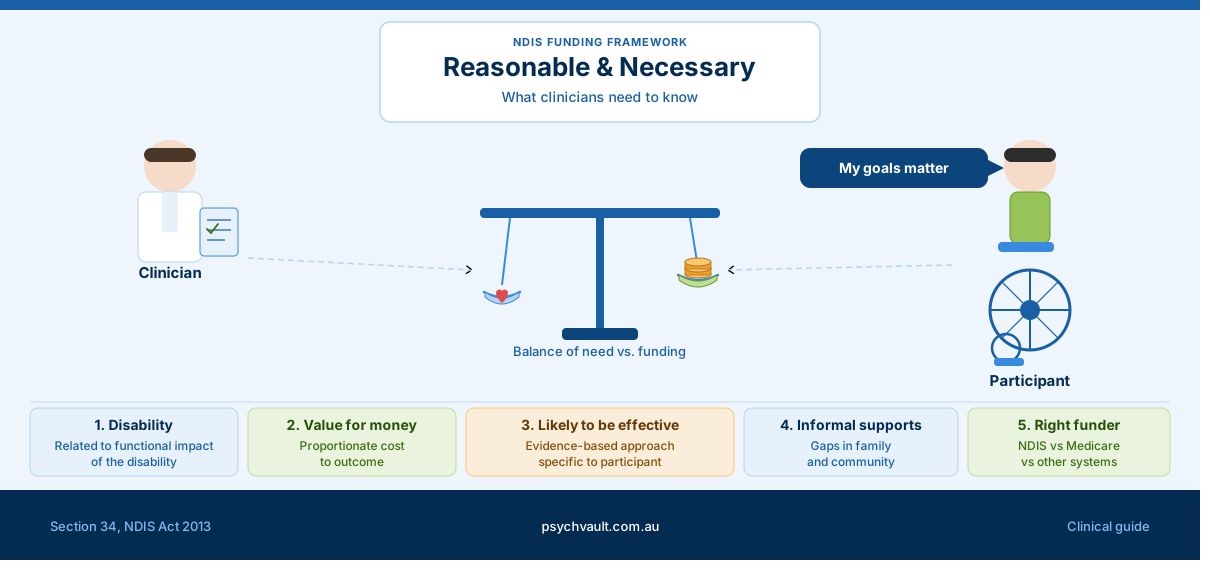
Understand the NDIS reasonable and necessary criteria and learn how to write psychology reports that justify supports clearly for Australian clinicians.

The NDIS still funds some psychology supports in 2026. Learn the difference between disability-related functional capacity building, clinical treatment, assessments, reports and pricing.