

NDIS Psychosocial Evidence: Does Someone Have to Try Every Treatment?
A guide for psychologists documenting psychosocial treatment history, prognosis and functional evidence, with current guidance and the scheduled 2028 changes.
Educational information, not individual clinical, legal or regulatory advice. No independent review is identified for this article. Editorial policy and corrections.
Scheduled review: 3 February 2027. This is not a completed review date.
“The client needs to try every treatment first.”
That sentence can leave a psychologist wondering what to put in an NDIS report. Does the treatment history need to cover every therapy approach? Does continuing therapy undermine the argument that an impairment is likely to remain? What happens when an option was recommended but never accessible?
The answer needs dates and clinical reasoning. Current NDIA psychosocial guidance does not require every treatment to be completed. However, it asks for an account of appropriate options and the reasons some were not pursued. Stricter statutory treatment requirements are scheduled for 2028. These should not be collapsed into one timeless rule. [1][2][3]
This guide focuses on psychologists preparing access evidence. It does not decide whether a particular applicant meets the requirements, and it is different from a report recommending a participant's next funded supports.
Current guidance checked 3 November 2026. This article separates guidance available at that date from changes scheduled for 1 January 2028. Guidance and rules may change earlier. The tables, workflow and fictional examples are editorial suggestions, not official NDIA forms or prescribed assessment methods. Independent legal review remains outstanding.
What current psychosocial guidance actually says
The two NDIA factsheets answer different questions.
Factsheet 3, Lifetime support and recovery, says all treatments do not need to be completed before impairment can be considered likely permanent. It also warns that where the treating clinician does not know the likely effect of treatment, the evidence does not establish likely permanence. [1]
Factsheet 6, Providing evidence, asks for exploration of appropriate available options, an explanation of options not pursued, and a reasoned prognosis. It identifies a GP or psychiatrist as the usual source of permanence evidence. Permanence alone is insufficient: functional evidence is also required. [2]
For the psychologist, this calls for a treatment account that explains what happened and what remains unresolved. A statement that the person “has exhausted treatment” leaves the reader unable to assess either.
The current Becoming a Participant Rules also matter. Rule 5.4 asks whether any known, available, appropriate treatment supported by evidence is likely to remedy the impairment. Rules 5.5–5.6 recognise that functioning may improve after permanence is established, and that an ongoing impairment may need further treatment or review before permanence can be demonstrated. Read those rules with the current Act; the older rules' summaries do not replace later statutory amendments. [4]
The NDIA also provides an Evidence of Psychosocial Disability form through its examples of disability evidence page. That page warns that information is being updated for legislative changes. [5]
Start by separating the questions
Before drafting, identify which question each piece of evidence answers.
| Question | What to document |
|---|---|
| What is the psychological presentation? | Relevant history, assessment findings, clinical formulation and source limitations |
| What treatment has occurred? | Approach, provider, dates, participation, adaptations and available records |
| What changed? | Symptom response and changes in everyday activity, described separately |
| What options remain? | The option, who recommends it, expected benefit and outstanding questions |
| What is the prognosis? | The opinion, its author, supporting evidence and limits |
| What can the person do? | Evidence of activity-related ability, distinguishing assistance and contextual influences |
| What help is currently provided? | Type, frequency and duration of assistance, recorded separately from an eligibility conclusion |
These distinctions also help when using a broader NDIS report structure and checklist. A well-organised report still depends on the assessment and reasoning supplied by its author.
Use one treatment-options register

A timeline, a list of remaining options and a rationale for options not pursued can be combined into one working register.
Use one row for each relevant option. Add detail only where it helps answer the referral question.
| Field | Suggested entry |
|---|---|
| Treatment and target | What was proposed or provided, and which symptoms or impairment-related difficulties it addressed |
| Source and date | Treating record, clinician correspondence, assessment or attributed client account |
| Status | Undertaken, ongoing, discontinued, recommended, not recommended or awaiting clarification |
| Participation | Dates, frequency, duration and adaptations, where known |
| Outcome | What changed, what did not, and how this was assessed |
| Medical reasons | Documented contraindications, adverse effects or other medical reasons; identify the practitioner and source |
| Clinical non-recommendation | Who did not recommend the option, the rationale and date; distinguish this from inability to undertake medical treatment |
| Client choice | The person's preference or decision, with its source; do not recategorise it as a medical reason |
| Access barriers | Cost, location, waiting list or other barriers, recorded separately from clinical suitability |
| Expected further effect | The relevant clinician's opinion and its supporting basis |
| Evidence base | The supporting evidence and its relevance to this impairment, with the source or unresolved question |
| Reliably expected material effect | The treating practitioner's reasoning about material improvement, reversal or alleviation of the impairment's impact |
| Australian provision | Whether it is regularly undertaken or performed in Australia, including information about available public funding |
| Outstanding action | Who will clarify the issue, what information is needed and the follow-up date |
The appropriateness fields prepare the record for a more specific enquiry. They are not a scoring system, and completing them does not establish that the statutory test is met.
Keep distinct reasons distinct. “Not recommended by the treating psychiatrist” is different from “recommended but unaffordable”. “Stopped after documented adverse effects” is different from “the client preferred another approach”. Do not convert one into another to make the application sound stronger.
Keep the working set to five components
The register can sit alongside four short documents. These are suggested ways to organise evidence, not a prescribed pack or a claim about an existing product's contents.
| Component | Purpose |
|---|---|
| Treatment options register | Bring together treatment history, outcomes, remaining options, separate reasons and supporting sources |
| Symptoms and function sheet | Compare symptom change with changes in everyday ability |
| Assistance and fluctuation log | Record observed performance, help provided and variability |
| Treating-practitioner questions | Clarify prognosis, medical options and unresolved evidence |
| Annotated excerpts | Show attribution, reasoning and limits in fictional report passages |
Stay within the evidence you can provide
Describe psychological treatment you delivered or assessed within your competence. Attribute earlier treatment to its source.
For example:
The client reports attending approximately eight sessions of a previous intervention. No treatment summary was available when this report was prepared. I cannot confirm its components, adaptations or outcome from the information currently available.
Medication trials, medical contraindications and medical treatment options need evidence from the appropriate practitioner. A medication list alone does not tell the psychologist whether a trial was adequate, why it ended or what further benefit is expected.
Where relevant, request a treating summary rather than making assumptions. Record consent or other applicable authority for information exchange, and identify which conclusions depend on information not yet received.
Preserve uncertainty and investigate what can be clarified

The warning in Factsheet 3 makes prognosis a consequential part of the evidence. [1] It is not an instruction to suppress uncertainty.
Before writing a broad statement such as “it is unclear whether further treatment would help”, ask what is actually unknown:
- Have previous records not been obtained?
- Has a recommended option not yet been assessed for suitability?
- Is the expected effect on symptoms known, while the effect on activity-related ability remains uncertain?
- Is the uncertainty outside the psychologist's competence?
- Do treating professionals disagree?
Ask the relevant clinician a specific question. Preserve any uncertainty that remains after clarification.
An attributed statement is more useful than an unsupported conclusion:
The treating psychiatrist's letter dated [date] addresses the expected effect of the remaining medical option. My opinion is limited to the psychological treatment described below. The effect of that medical option is outside the scope of my assessment.
If the available evidence cannot support a prognosis, say so. Do not ask another practitioner to certify a predetermined outcome.
Describe symptoms and function separately

A symptom score and an account of everyday ability answer different questions. Comparing both over time can make the treatment response easier to understand.
| Symptom information | Activity-related information to examine |
|---|---|
| Distress reduced during treatment | Whether the person can now initiate and complete relevant activities with less assistance |
| Panic became less frequent | Whether communication, travel-related tasks or participation changed, and what evidence supports that account |
| Sleep improved | Whether daily sequences became more consistent or still depend on another person's prompting |
| The client appears settled in a session | Whether that observation reflects ability beyond the supported appointment, and what additional evidence is available |
These are assessment prompts, not assumed relationships. Improvement in one area does not prove improvement or ongoing impairment in another. Equally, unchanged questionnaire scores do not establish unchanged functional capacity.
Use the person's account, observations, relevant assessment and collateral information with clear attribution. Explain disagreements rather than averaging them away.
Functional capacity already has a statutory definition
Section 9B already applies to relevant decisions about disability and early intervention requirements made from 27 August 2026, including decisions concerning existing participants. It concerns ability without help, subject to commonly used assistive technology or modifications the person would ordinarily use, and age-appropriate help for children. It asks for personal and environmental influences to be excluded as far as possible. [3][6]
Reports should therefore distinguish impairment-related ability from observed performance with support. Record the task, assistance, aids and setting; explain which influences can be separated and the limits of that inference. This reporting approach is an editorial suggestion, not a prescribed method under section 9B.
For example, a family member completing a task does not demonstrate that the person can complete it independently. Nor does a missed task automatically establish that impairment caused the difficulty.
Do not withdraw necessary assistance to manufacture unsupported performance. Use existing records and appropriate assessment, and identify any inference about ability without support.
An assistance and fluctuation log can record:
- the activity and observation date;
- what the person initiated and completed;
- assistance or aids used;
- who provided the information;
- variation over time;
- possible contextual influences;
- what remains uncertain.
Treat these observations as evidence to interpret, not an eligibility checklist.
Fictional example of evidence that needs clarification
Jordan has attended psychological treatment over several years. A recent symptom measure shows improvement. Their partner reports continuing to organise appointments and prompt several daily routines. An earlier medical letter mentions another treatment option but does not explain its likely effect on the impairment.
A report stating “Jordan has tried everything and remains severely impaired” would overstate the record.
A more transparent account would separate the findings:
During the treatment period, Jordan's reported distress reduced on [measure, dates and results]. Their partner reports continuing to organise appointments and provide prompts for [specified activities and frequency]. These accounts require interpretation alongside the assessment findings and the assistance already in place. I have not independently observed every reported activity.The medical letter dated [date] identifies a further option but does not state its expected effect on the impairment. With Jordan's consent, clarification has been requested from the treating practitioner. This report does not conclude that all relevant treatment options have been addressed.
The next action is to obtain and evaluate the missing information. The example does not establish whether Jordan meets the access requirements.
Changes scheduled for 1 January 2028

Schedule 1 Part 8 changes the permanence test from 1 January 2028. A person must have undertaken all appropriate treatment, and the impairment must be likely to persist throughout their life. This is a stricter statutory requirement. [3]
The new section 25A requires three things of an appropriate treatment: an evidence base; a reliable expectation of materially improving, reversing or alleviating the impairment's impact; and regular use or performance in Australia. A note connects that last limb to available public funding. [3]
The built-in exception concerns appropriate medical treatment that cannot be undertaken for medical reasons. Rules may add circumstances. Financial or geographical barriers do not automatically make treatment inappropriate. Recording an access barrier therefore does not itself establish an exception. [3]
Other service systems need a separate check
Part 9 also begins on 1 January 2028. Its alternative-support provisions address compensation and other service systems, with specific application provisions. Item 100 applies the new access requirement to requests made from that date; item 101 applies the new revocation ground to people who become participants from that date. A compensable injury should trigger a check of the law, rules and person's circumstances, rather than a blanket conclusion that access is excluded. [3]
What the rules check established
The Register identifies the February 2018 compilation of the Becoming a Participant Rules as its latest version. The Department describes additional treatment rules as still to be developed through consultation. That policy explanation is not itself a legislative instrument. [7][4]
The checks for this article did not identify a new instrument settling the section 9B assessment methods, section 25A exceptions or section 25B alternative-support details. This is a limit of the check, not proof that no relevant rule exists. Confirm the applicable instruments and application provisions for the decision concerned, particularly where compensation or another service system may be involved. Independent legal review remains outstanding.
Questions for the treating GP or psychiatrist
Use focused requests that the practitioner can answer from their records and expertise:
- 1Which treatment options remain relevant to the identified impairment?
- 2What benefit is expected from each, and on what basis?
- 3Is that expected benefit primarily symptom change, altered activity-related ability, maintenance or another outcome?
- 4Why was a previously recommended option not undertaken or discontinued?
- 5Are there documented medical reasons affecting suitability?
- 6Which prognosis can be supported, and what uncertainty remains?
- 7Which records or assessments would help resolve the outstanding questions?
Ask for clarification of the evidence. Avoid a request that simply asks the practitioner to endorse “all treatments exhausted”.
Using a report template
A template can hold the treatment register, sources, functional evidence and outstanding questions together. Check whether its prompts distinguish clinical findings from attributed information and legal conclusions.
PsychVault's NDIS report template checklist explains broader report structure and links to the optional NDIS Functional Capacity Report Toolkit for Psychologists, sold through PsychVault. PsychVault is the platform publishing this article. Review the product preview and current description before purchasing; this article does not claim that the toolkit contains the proposed specialist psychosocial register.
A general report template cannot supply an individual prognosis or establish access eligibility. The clinician still needs to assess, interpret, attribute and review the evidence.
Before finalising the evidence

- State that the report concerns access evidence, where that is its purpose.
- Separate treatment delivered from treatment merely recommended or reported.
- Attribute medical opinions and identify missing records.
- Describe symptom response and activity-related findings separately.
- Distinguish assistance received from ability without that assistance.
- Explain uncertainty without overstating what a further treatment will or will not achieve.
- Keep the current position separate from amendments scheduled for 2028.
- Check current legislation, rules and official guidance for the decision concerned.
- Discuss the report with the person, including factual corrections and any disagreement, without treating agreement as proof of the conclusions.
Can the reader see what was tried, what changed, what remains uncertain and who is addressing the next question?
Sources
Review: suggested review 3 February 2027, or earlier if relevant rules, commencement provisions or NDIA guidance change. Recheck the scheduled 2028 position before relying on it.
- 1.NDIA: Psychosocial Disability Access Factsheet 3, Lifetime support and recovery. See page 4 for treatment completion and uncertainty about treatment effects.Back
- 2.NDIA: Psychosocial Disability Access Factsheet 6, Providing evidence for NDIS eligibility. See pages 3–4 for treatment rationale, permanence and functional evidence.Back
- 3.National Disability Insurance Scheme Amendment (Securing the NDIS for Future Generations) Act 2026. See section 2 and Schedule 1 Parts 1, 8 and 9; distinguish commencement from enactment.Back
- 4.National Disability Insurance Scheme (Becoming a Participant) Rules 2016, latest text. The Register identified compilation F2018C00165, dated 27 February 2018. See rules 5.4–5.6 alongside the current Act.Back
- 5.NDIA: Examples of disability evidence. Includes psychosocial evidence and the Evidence of Psychosocial Disability form. The page carries a notice that information is being updated for legislative changes.Back
- 6.National Disability Insurance Scheme Act 2013, current compilation. See sections 9B and 24. The latest compilation retrieved for this article was dated 1 October 2026.Back
- 7.Department of Health, Disability and Ageing: About the changes to the NDIS. The treatment section describes additional rules as forthcoming; policy explanations do not replace enacted provisions or registered instruments.Back
Discussion
Share your thoughts and experiences with this resource.
Sign in to leave a comment
Comments
Therapist Resources for Australian Clinicians
Continue with the complete therapist resources for australian clinicians collection.
Browse Therapy Worksheets
Find templates, handouts, and clinical tools created for use in real psychology and allied health work.
Continue exploring Therapist Resources for Australian Clinicians

Document family help, functional capacity and carer sustainability in NDIS reports, with separate guidance for access evidence and planning.
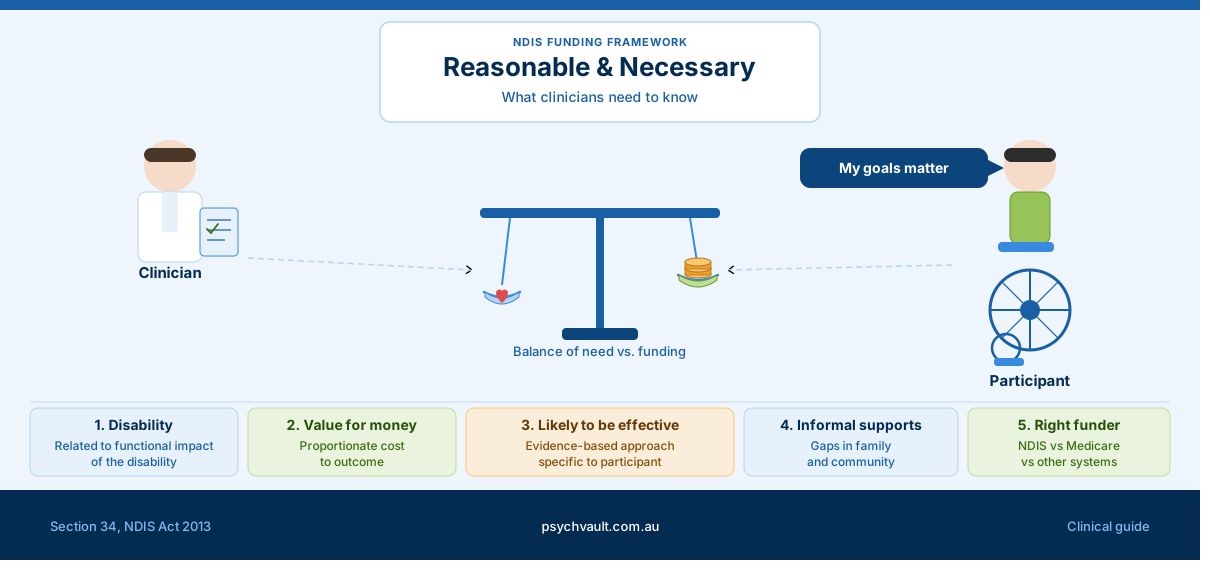
Understand the NDIS reasonable and necessary criteria and learn how to write psychology reports that justify supports clearly for Australian clinicians.

A six-step guide to NDIS psychology funding decisions: check the review pathway, map the stated reasons to evidence and write a focused report addendum.