

How Much Psychology Support Should You Recommend in an NDIS Report?
Explain psychology support frequency, duration, indirect work and review points in NDIS reports, with a worked example and recommendation checklist.
Educational information, not individual clinical, legal or regulatory advice. No independent review is identified for this article. Editorial policy and corrections.
Scheduled review: 1 February 2027. This is not a completed review date.
You have described the participant's difficulties, gathered information and explained the functional impact. Then you reach the recommendation:
“Fortnightly psychology for 12 months.”
Why fortnightly? Why a year? What would happen during those sessions, and how would you know whether that amount still fits?
A recommendation has to make those decisions understandable. The number of hours is the result of the reasoning. It can't do the reasoning for you.
This article offers a framework for moving from an identified need to a proposed amount of psychology support. It focuses on planning and reassessment reports. For the wider report structure, see the NDIS report template checklist and report-writing guide.
Information checked 8 November 2026. The workflow and fictional examples below are my own approach. They aren't an NDIA formula or a prescribed therapy schedule, and they don't determine eligibility, funding or claiming permission. NDIA guidelines currently describe the old planning framework while rules for the new framework are developed. [1]Three changes affect what a recommendation feeds into:- Pricing, effective 24 September 2026. Direct work, non-face-to-face work, provider travel, cancellations, telehealth and NDIA-requested reports have separate item numbers in the 2026-27 schedule. [2]- Funding reset, from 1 October 2026. Affected Improved Daily Living Skills allocations are reduced by 10% as plans are created or reassessed from 1 October 2026, or renewed from 1 February 2027, during the rollout ending 30 September 2027. Exclusions apply. [3][4]- Law changes, from 1 February 2027. The Act changes how the NDIA weighs evidence, cost and other service systems, and old framework plans renew automatically on their end date. [5]
Find out whether a reassessment, renewal or another process is expected before agreeing the report's scope. Unscheduled-reassessment restrictions commenced on 27 August 2026; the renewal provisions commence on 1 February 2027. Renewal is not a fresh assessment of every support and does not guarantee unchanged available funding. [5] Ask the participant what the NDIA has actually requested.
There is no useful answer without an assessment question
“How many hours does someone with this diagnosis get?” starts too far from the individual.
The NDIA decides each support, and the amount of it, individually and as part of the overall package. [1] A clinician's recommendation informs that decision. It doesn't set an allocation. The NDIA also says it can't include an amount that doesn't meet the funding criteria, and that supports funded in one plan may not be funded in the next once the skills have been built. [1]
Start with a more specific question:
What psychological work is proposed for this person's disability-related functional needs, and what amount is reasonably supported by the available evidence?
For example, “emotional regulation” could mean difficulty recognising overload, communicating a need for a break, recovering after conflict, or applying a familiar strategy outside sessions. Those are different targets. They may need different approaches and different amounts of support.
Identify the activity, the difficulty, the assistance already provided and the intended change before choosing the appointment schedule. Also consider whether the proposed work belongs within the NDIS or another service system. The NDIA treats supports that are the responsibility of the health and mental health systems as not NDIS supports. [1] See Does the NDIS still fund psychology? for that distinction.
Build the recommendation in six parts

The following questions are a suggested writing framework.
| Part | Explain |
|---|---|
| Functional target | Which activity or participation difficulty is being addressed? |
| Proposed work | What will the psychologist do, why does the approach suit this person, and what is the evidence for it? |
| Frequency | Why are appointments proposed at this interval? |
| Duration and quantity | Over what period, with how many sessions or hours? |
| Work outside appointments | What specific tasks are proposed, for what purpose and estimated time? |
| Review | What will be checked, with which measures, when, and what would change the plan? |
The NDIA's reassessment-report guidance asks clinicians to describe the type of service, approach, duration, frequency, goals and intended outcomes. It also asks for evidence of progress, including the assessment measures you used to quantify it, any barriers and risks, and justification for more or different supports. [6]
Use that evidence to explain your recommendation. Don't repeat the previous allocation.
What the NDIA weighs, and what changes on 1 February 2027
The NDIA currently asks whether a support is effective and beneficial, represents value for money, and takes account of what family and other informal supports can reasonably provide, among other criteria. [7][1] From 1 February 2027 the Act adds detail. [5]
- Effective and beneficial: Where two or more listed evidence types are considered, the order is generalisable, published, peer-reviewed research; evidence of effectiveness in the participant's circumstances; previous-plan outcomes; then other appropriate matters. Limited research or participant-specific evidence can still leave the decision-maker unsatisfied.
- Value for money: Lower-cost comparable supports must be considered, including whether they offer better value.
- Other systems: A support must not be more appropriately provided or funded by another scheme or existing government service system.
The reporting implication is to explain the evidence for the approach, its fit for this participant and the observed outcomes. Research on an intervention does not necessarily establish the optimal appointment interval or total hours for this individual. Keep those inferences explicit.
These amendments have not commenced as at the checked date. Their practical application should be checked against subsequent guidance; this article does not predict individual decisions.
Explain frequency through the work being proposed

Weekly, fortnightly and monthly appointments are schedules. They become clinical recommendations when you explain why the interval fits the person and the work.
Questions worth considering include:
- How much new material can the person use comfortably in one appointment?
- What time is needed for practice, recovery or feedback between appointments?
- What happened with the previous schedule, if one was trialled?
- Does the person need repetition or help applying a strategy in different situations?
- Are fatigue, sensory demands, communication needs or competing appointments affecting participation?
- Could a different format or delivery approach improve access?
Avoid treating the intensity of distress as a direct conversion into therapy hours. Work out what is driving the distress and what response it needs. Urgent clinical or safety needs get an appropriate response when they arise. An NDIS funding request isn't an urgent-care pathway.
Explain the alternative you considered
A short comparison can clarify your judgement:
“A monthly interval was considered. During the previous treatment period, the participant reported difficulty recalling and applying the agreed strategy across that gap. A shorter initial interval is proposed to support rehearsal and feedback, with frequency reconsidered at the first review.”
Only use that reasoning when the history supports it. If another interval hasn't been trialled, say the proposed schedule is an initial clinical estimate and explain the basis for it.
Separate the review point from the end of the support need
A proposed block of work can have a review point without implying that all disability-related support needs should resolve by then.
Distinguish:
- The initial delivery period: when the proposed work would occur.
- The review point: when its usefulness and amount would be reconsidered.
- The longer-term need: what remains uncertain or may require ongoing support.
NDIA guidance distinguishes therapy that builds skills from maintenance therapy that helps people keep their everyday abilities or prevent or delay decline. A mix may suit some people. [8] The NDIA also notes that supports funded to build skills may not be funded again once those skills are built. [1]
For a maintenance recommendation, explain what function the work is meant to maintain, the evidence for that purpose and how continued benefit will be reviewed. Avoid promising improvement where maintenance is the realistic goal. A plateau alone doesn't show that continuing the same approach is useful, either.
Make indirect work visible and specific

“Plus five hours of non-face-to-face work” leaves several questions unanswered.
Name each proposed task and its connection to the participant's support:
| Proposed task | What the report should explain |
|---|---|
| Reviewing relevant outcome information | Which information, what decision it informs and estimated time. |
| Consultation with others involved, such as another treating professional, a supporter or a group facilitator | The agreed question, each person's role, consent, and how duplication will be avoided. |
| Developing an individualised strategy resource | Why the participant needs it and how its usefulness will be checked. |
| Writing a progress or reassessment report | Purpose, scope, estimated work and expected recipient. |
The table lists work to describe. Whether each task is claimable is a separate check.
Separate the clinical rationale from the billing check. Verify the relevant item, provider requirements, plan arrangements, claiming conditions and any advance agreement. The 2026-27 pricing schedule gives direct work, non-face-to-face work, NDIA-requested reports, provider travel, cancellations and telehealth their own item numbers. [2] Check which item each proposed task falls under, including whether a report you write without a request counts as an NDIA-requested report. Don't convert routine business administration into participant-specific clinical work by changing its label.
The NDIA's pricing page hosts the 2026-27 Pricing Schedule effective 24 September 2026. It sets maximum prices and separately says updated pricing and claiming guidance will follow; the page also retains older documents. Don't treat the prices-only schedule as a complete claiming manual. [9] A price limit or a cost estimate doesn't establish that a proposed activity can be invoiced.
A fictional worked example

This example demonstrates reasoning and arithmetic. Its hours are invented for teaching and should not be copied as a standard allocation.
Sam is an adult participant who wants to remain involved in a chosen community group. Sam reports leaving early when overwhelmed and finding it difficult to ask for clarification or a break.
Across recent appointments, Sam used a short written request during rehearsal. Sam reports using it at the group once, with a reminder from a supporter. There has been no direct observation at the group. Sam would like to practise the request further and explore ways to recognise the need for a break earlier.
Proposed recommendation wording
“An initial block of six 60-minute psychology appointments over approximately 12 weeks is proposed, generally at fortnightly intervals. The work would focus on recognising early signs of overload, rehearsing Sam's preferred request for assistance and reviewing its use during the community activity.The interval is an initial clinical estimate intended to allow opportunities for practice and feedback between appointments. It has not been established as the optimal frequency. Sam prefers this schedule to weekly appointments because of the recovery time needed around other commitments.Progress and fit will be reviewed after appointment three and at the end of the block. With Sam's agreement, review information will include Sam's experience, opportunities to participate in the chosen activity, use of the request and the assistance involved, recorded against the goal Sam set at the start. Increased attendance alone will not be treated as success if it comes with an unacceptable recovery cost.Limited consultation with Sam's supporter and the group facilitator, with Sam's consent, and review work are proposed below. Any further treatment recommendation will depend on the review findings. Current information does not establish a need for the same frequency throughout a full year.”
Show the calculation separately
| Proposed component | Calculation | Estimated hours |
|---|---|---|
| Direct psychology appointments | 6 × 60 minutes | 6.0 |
| Consultation with Sam's supporter and the group facilitator, with consent | 2 × 30 minutes | 1.0 |
| Review and integration of outcome information | 1 × 30 minutes | 0.5 |
| Focused progress report | 1 × 90 minutes | 1.5 |
| Total proposed work | 360 + 60 + 30 + 90 minutes | 9.0 |
The review discussions within appointments are included in the six direct hours. They aren't added again. The separate review time is for the specific integration task listed above.
Each indirect component needs its own billing check against the schedule's separate items. If a task can't be claimed as proposed, resolve that before agreeing to deliver and invoice it. Explain any changed scope or costs to Sam.
What if the available budget is smaller?
The government has announced a 10% reduction to affected Improved Daily Living Skills allocations. NDIA guidance separates new and reassessed plans from renewals, which are affected from 1 February 2027. Current supports remain available until the relevant plan change. The reduction concerns budget availability, not a 10% reduction in each psychology fee or recommended session count. [3][4]
Psychology may draw on the same allocation as other therapies. Check the actual category, support item, exclusions and funding notice. Don't assume every psychology service belongs to one category or every participant's psychology budget falls by the same amount. The supplied September 2026 NDIA exclusions spreadsheet contains 98 support items. No item is named as psychologist or psychology support. Its Therapeutic Supports entries are six audiologist items, rather than a blanket exemption for therapies. Standard psychology is therefore not listed as exempt in that spreadsheet. Match the actual support item and current NDIA notice before applying this finding to a particular allocation. [10]
Recommend the work supported by the evidence, then discuss any funding shortfall with Sam. Record the original recommendation separately from a revised delivery agreement. Consider clinically appropriate priorities, alternative services and continuity risks. Avoid suggesting that reporting or coordination can simply be delayed when they are necessary for safe care. Escalate unresolved needs through the appropriate participant-led pathway rather than silently describing a smaller affordable service as the full assessed need.
If rates differ by activity, calculate each component separately. This example deliberately avoids a fixed dollar rate so it doesn't become a stale price guide.
Explain value and alternatives without assuming unpaid help
Consider whether the proposed work duplicates another service or could be delivered in a way that better fits the participant. Where more than one professional is involved, explain the roles.
Alternatives might include a different appointment interval, a suitable group, an accessible delivery format or focused collaboration with an existing provider. Assess suitability. Don't assume a lower-cost option meets the same need. This matters more from 1 February 2027, when decision-makers must consider whether a comparable lower-cost support would be better value. [5] If your proposal isn't like-for-like with the cheaper option, say why.
Don't build family availability into a cheaper proposal without checking it. Establish willingness, capacity, consent and sustainability before recommending a role for an informal supporter. The NDIA considers carer age and capacity and, for adults, the long-term effects on carers' health and safety. [1] The guide to informal supports in NDIS reports gives examples of documenting that assistance and its sustainability. Likewise, don't replace a qualified professional's work with delegated tasks without checking competence, oversight and applicable requirements.
Address limited progress and uncertainty honestly
Before recommending more of the same, ask:
- Was the proposed work actually delivered at the intended frequency?
- Was the target relevant to the participant?
- Were the approach and communication accessible?
- Were there opportunities to apply the work outside sessions?
- Did progress occur in one area while another stayed the same?
- Does the evidence support changing the approach, referral, maintenance work or further assessment?
Specify what is known and what is still an estimate. A recommendation can be useful while remaining provisional.
For examples of documenting progress alongside continuing needs, see psychology report progress and ongoing support.
The NDIA asks what risks the participant faces if the recommended supports aren't provided. [6] Answer that proportionately. Separate observed changes, reported experiences and anticipated risks. Avoid predicting hospitalisation, loss of housing or deterioration unless the evidence supports it.
Optional templates for organising the recommendation
Commercial disclosure: I created these paid MindFrame resources, which are sold through PsychVault, the platform publishing this article.
The NDIS Functional Capacity Report Toolkit for Psychologists is an editable Word template with report prompts, assessment tables, functional-impact sections and space for recommendations. It may suit a broader report where the recommendation needs to sit alongside assessment evidence.
The NDIS Psychological Quote Letter Template is a shorter Word resource. Its listing includes participant background, functional impact, proposed intervention, goals and an itemised funding estimate. It is described as a targeted letter rather than a full functional assessment.
Review the current listings and previews before purchasing. Neither resource calculates the appropriate amount of therapy, establishes funding eligibility or replaces individual assessment. The worked example is provided in this article. It is not advertised as included in either download; check the current previews for the contents supplied.
Before signing the report
Check that a reader can identify:
- 1The disability-related functional need and evidence source.
- 2The psychological work proposed and why it fits.
- 3The evidence for the approach, and the reasoning behind frequency and duration.
- 4The quantity of each activity, with correct arithmetic.
- 5The purpose of each indirect component.
- 6Alternatives considered and any overlap with other services.
- 7Outcomes, the measures you'll use, review points and conditions for changing the recommendation.
- 8Uncertainty and the limits of your opinion.
- 9The participant's preferences and involvement.
- 10The distinction between recommended work, estimated costs and permission to claim.
The NDIA asks clinicians to share reassessment reports with participants, and uploading to the provider portal needs the participant's consent. [6] Discuss the recommendation in language the participant can use, including any uncertainty about the amount proposed.
If someone asks why you recommended those hours, the answer should already be in the report.
Sources
Official guidance and legislation accessed 8 November 2026. The practical questions, tables and fictional example are my own synthesis, not a prescribed NDIA assessment method.
- NDIA Our Guideline: Reasonable and necessary supports, 1 October 2026.Back
- NDIA: Pricing Schedule 2026–27, effective 24 September 2026.Back
- Department of Health, Disability and Ageing: Funding changes for NDIS supports.Back
- NDIA: Changes to support budgets from 1 October, including its linked list of excluded supports. The announcement and the supplied September 2026 exclusions spreadsheet were reviewed. Check for subsequent updates.Back
- National Disability Insurance Scheme Amendment (Securing the NDIS for Future Generations) Act 2026, Schedule 1, Parts 2, 5 and 6.Back
- NDIA: How to write a plan reassessment report.Back
- NDIA: What is reasonable and necessary.Back
- NDIA: What are therapy supports.Back
- NDIA: Pricing arrangements.Back
- NDIA: List of supports not affected by the budget reductions, September 2026 spreadsheet. Reviewed from the official file supplied for this article on 8 November 2026; 98 support-item rows.Back
Discussion
Share your thoughts and experiences with this resource.
Sign in to leave a comment
Comments
Therapist Resources for Australian Clinicians
Continue with the complete therapist resources for australian clinicians collection.
Browse Therapy Worksheets
Find templates, handouts, and clinical tools created for use in real psychology and allied health work.
Continue exploring Therapist Resources for Australian Clinicians

Document family help, functional capacity and carer sustainability in NDIS reports, with separate guidance for access evidence and planning.

A guide for psychologists documenting psychosocial treatment history, prognosis and functional evidence, with current guidance and the scheduled 2028 changes.
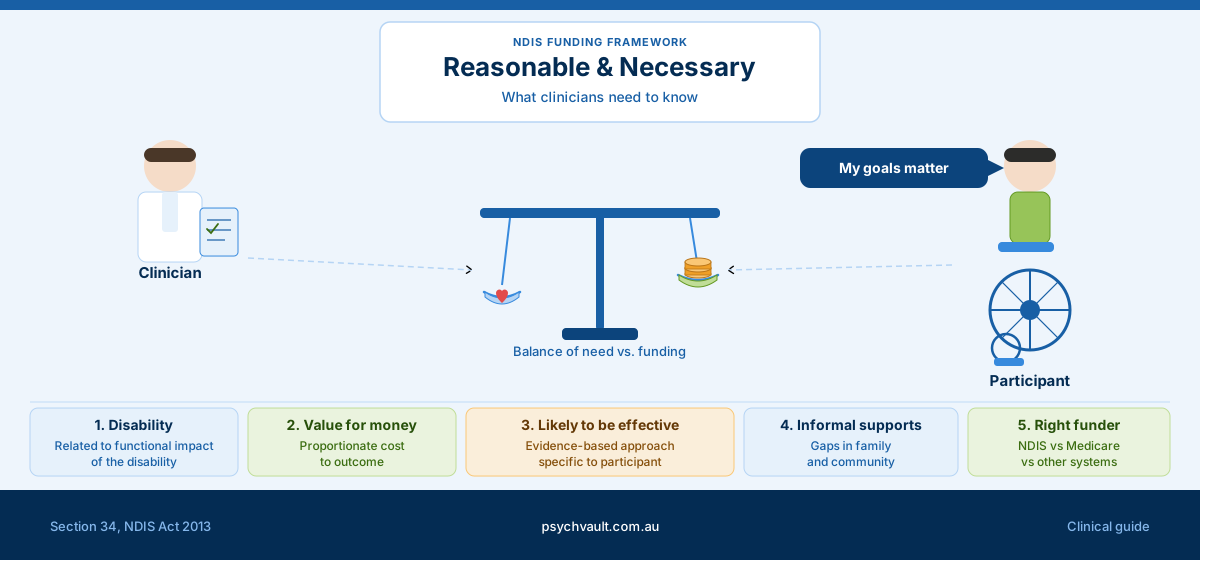
Understand the NDIS reasonable and necessary criteria and learn how to write psychology reports that justify supports clearly for Australian clinicians.