
PsychVault
HomeBrowseStoresBlogSell
AboutContactFAQFeedbackCareersTemplatesToolsCategories
PsychVault

Discover and sell psychology resources that save time in real clinical work.

hello@psychvault.com.au
FacebookInstagramLinkedInPinterest

Browse

All resourcesCreator storesBlogTemplatesToolsFree resourcesBest sellersTop rated

Creators

Sell on PsychVaultHow uploading worksStore setup checklist

Support

ContactFAQFeedbackCareersEditorial policyPrivacy policyTerms of serviceRefund policy

Acknowledgement of Country

PsychVault acknowledges Aboriginal and Torres Strait Islander peoples as the Traditional Custodians of Country across Australia. We pay respect to Elders past and present, and recognise the continuing cultural, spiritual, and physical connection First Nations peoples hold with lands, waters, and communities.

PsychVault aims to be inclusive of First Nations peoples, LGBTQIA+ communities, neurodivergent people, and the clinicians and clients who support them.

Australian Aboriginal Flag
Torres Strait Islander flag
LGBTQIA+ inclusive
∞Neurodiversity affirming

Made in Australia for Australian psychologists and allied health professionals.

Resources from independent creators for Australian psychology and allied health practice.

© 2026 PsychVault · RSS · Sitemap

Professional and regulatory links

Psychology Board of AustraliaAustralian Psychological SocietyAustralian Association of Psychologists Inc (AAPi)

These are external reference links. They do not imply endorsement, membership or accreditation of PsychVault.

Home/Blog/What Can Psychologists Charge the NDIS For?
Two small figures approaching overlapping textured rings, illustrating alignment before claiming NDIS psychology supports
NDIS ResourcesNDIS psychologyNDIS billingnon-face-to-face supports

What Can Psychologists Charge the NDIS For?

A practical 2026 guide to NDIS psychology billing for sessions, telehealth, reports, non-face-to-face work, travel and cancellations.

By Ethan Smith10 October 202614 min read2970 words
Share

The 2026–27 NDIS Pricing Schedule contains separate psychologist items for direct services, telehealth, non-face-to-face work, provider travel, cancellations and NDIA-requested reports.

That does not mean every activity with one of those labels can automatically be charged to a participant's plan.

A defensible psychology invoice needs more than a matching item number. The work must be an NDIS support for that participant, relate to their disability and plan, fit the selected item and claim type, comply with the current pricing rules, and have been explained and agreed in advance where required.

This guide explains the practical differences.

Information current at 10 October 2026. The Minister made the first statutory NDIS pricing determination on 24 September 2026. The NDIA says the 2026–27 Pricing Schedule will be updated later in 2026 following Fair Work Commission changes. The schedule chiefly sets support items and maximum prices. Unlike the former Pricing Arrangements and Price Limits document, it does not contain the complete detailed claiming rules, so the support catalogue and forthcoming updated claiming guidance still matter. The government is also consulting on differentiated pricing based on whether a provider is registered or unregistered. The NDIA recommended a 1 January 2027 start, but no such change is in force at the date of this article. Check the current pricing arrangements and schedule, pricing updates and support catalogue before relying on a claim type. This article provides general information, not billing, legal or financial advice.

The short answer

A psychologist may be able to charge NDIS funding for:

  • a disability-related psychology session delivered face to face
  • an agreed telehealth session
  • participant-specific non-face-to-face work that is directly connected to delivering an eligible support
  • a report requested by the NDIA using the applicable report item
  • other participant-specific report work where an eligible claim pathway applies and the work was agreed in advance
  • provider travel when the support item permits it and the travel conditions are met
  • a short-notice cancellation when the item permits cancellation claiming and all current conditions are met
  • employment-focused or early-childhood psychology supports under the relevant items

A psychologist should not assume they can charge NDIS funding for:

  • routine practice administration
  • preparing invoices or submitting payment claims
  • establishing or updating ordinary client records
  • developing a service agreement
  • staff rostering, training or general supervision
  • work unrelated to the participant's disability support
  • the same service already claimed through Medicare, private health insurance or another funding system
  • a report simply because the clinician believes it would be useful
  • a cancellation that does not meet the current claiming conditions

A pricing item is not permission to claim

The NDIS Support Catalogue lists the available support items and identifies which claim types may apply. The pricing schedule sets maximum prices for NDIA-managed and plan-managed participants.

Neither document independently decides whether a particular piece of work can be paid from a particular participant's plan.

Before invoicing, ask five questions:

  1. 1Is this an NDIS support? The purpose must be disability-related rather than ordinary healthcare, diagnosis or general mental-health treatment.
  2. 2Is it in line with the participant's plan? A listed item does not create funding that is absent or unavailable in the plan.
  3. 3Does this item permit the claim type? Direct service, telehealth, non-face-to-face work, travel, cancellation and requested reports are different claim types.
  4. 4Was the work explained and agreed? The participant should understand what will be done, why it is useful and what it will cost.
  5. 5Can the provider evidence the work? The invoice and clinical record should identify what occurred, how long it took and how it related to the participant's support.

If one of those questions cannot be answered clearly, the presence of an item number does not resolve the problem.

Current psychologist price limits

The current schedule includes psychologist items across therapy and professional supports, employment supports and early-childhood supports.

For several psychologist items, the published hourly maximums are below. The national figure is up from $232.99 in 2025–26.

LocationDirect, telehealth, non-face-to-face, cancellation and NDIA-requested report itemsProvider travel
National$252.99$126.50
Remote$354.19$177.10
Very remote$379.49$189.75

These are maximum prices, not compulsory fees or an entitlement to charge the maximum. The limits apply to NDIA-managed and plan-managed participants. Self-managed participants can negotiate prices above or below the schedule, but the purchase must still be an NDIS support, relate to the participant's disability and be in line with the plan.

Providers must also consider the NDIS Code of Conduct and fair-pricing requirements. Charging an NDIS participant materially more than another customer for the same service without a defensible reason may raise price-differentiation concerns. Registered providers also cannot add charges on top of the price of a support, such as gap fees or card surcharges.

Direct psychology sessions

A direct-service item is the clearest category, but the clinical purpose still matters.

The NDIS may fund psychology directed towards disability-related functional capacity, independence and participation. Examples might include work on:

  • communicating needs across settings
  • developing routines for everyday activities
  • increasing capacity to participate in education, employment or community life
  • building disability-related emotional-regulation skills
  • reducing reliance on informal support through structured capacity building
  • maintaining function where deterioration would otherwise be expected

An appointment does not become an NDIS support simply because the client is an NDIS participant. Diagnosis, medication management and treatment of a mental-health condition are generally health-system responsibilities. Some sessions involve both clinical treatment and disability-related capacity building, which makes the goals, records and funding decision especially important.

For the broader funding distinction, see Does the NDIS Still Fund Psychology in 2026?.

Telehealth

The schedule contains separate psychologist telehealth items at the same published maximum hourly amounts as direct service.

Telehealth should still be:

  • clinically appropriate
  • accessible and safe for the participant
  • connected to an eligible disability-related support
  • agreed with the participant
  • documented as telehealth rather than face-to-face delivery
  • billed for the time actually delivered

The availability of a telehealth item does not justify charging for a failed connection, an unplanned telephone exchange or ordinary appointment administration as though a full therapy session occurred.

The service agreement should explain when telehealth may be used, the applicable price, how privacy will be managed and what happens if technology fails.

A clinician and participant inside a textured arch, separated from a cluster of blocks representing ordinary administration

Non-face-to-face work

Non-face-to-face work is easy to get wrong.

It does not mean any work completed while the client is absent. It should be participant-specific work that forms part of delivering the agreed disability support.

Depending on the current catalogue and claiming guidance, examples may include:

  • reviewing participant-specific information before a clinically necessary intervention
  • scoring or interpreting an agreed functional measure
  • preparing participant-specific materials required for intervention
  • clinically necessary communication with another provider
  • an agreed case consultation directly connected to the participant's goals
  • documenting progress for a participant-specific support purpose
  • preparing report content where the applicable non-face-to-face pathway permits it

The provider should be able to explain:

  • what was done
  • why it was necessary
  • how it related to the participant's disability support and goals
  • why it represented an appropriate use of the participant's budget
  • how the time and fee were calculated
  • when the participant agreed to the work

Non-face-to-face work is not ordinary administration

Routine business activities should not be relabelled as clinical work. Examples include:

  • opening a file
  • entering contact or billing details
  • booking or moving appointments
  • preparing the service agreement
  • processing an invoice
  • submitting a payment claim
  • monitoring the practice's general workflow
  • staff training or ordinary supervision
  • maintaining systems required to operate the business

Older NDIS pricing guidance expressly treated these activities as provider overhead rather than participant-specific non-face-to-face supports. Because updated 2026–27 claiming guidance is still being published, providers should confirm the current rules rather than assuming the wording has carried forward unchanged.

Case consultation and communication with other people

A case conference, telephone call or email is not automatically billable because it concerns a participant.

The stronger case for claiming exists when the communication:

  • is clinically necessary to deliver the agreed NDIS support
  • directly relates to the participant's disability goals or functional outcomes
  • requires the psychologist's professional input
  • is permitted under the relevant item and claim type
  • has been explained and agreed in advance
  • is documented with the participants, purpose, duration and outcome
  • occurs with appropriate consent for information sharing

General networking, chasing routine paperwork, discussing business arrangements or attending a meeting primarily for another organisation's administrative purpose should not automatically be charged to the participant.

Where several providers attend, the participant should understand that multiple services may invoice for the same meeting. Advance cost disclosure matters because one meeting can reduce several parts of a participant's budget at once.

Reports

The current schedule includes a psychologist item specifically labelled NDIA Requested Reports.

The label matters. It should not be treated as a general report-writing item for every letter, progress summary, plan reassessment report or privately requested document.

Before using an NDIA-requested report item, retain evidence of:

  • who requested the report
  • what was requested
  • the relevant due date and purpose
  • the agreed scope
  • the estimated and final time
  • the report supplied

Other participant-specific reporting may sometimes be claimable through an eligible non-face-to-face pathway, but that depends on the item, plan, current claiming guidance and prior agreement. Providers should not quietly deduct several hours for a report when the participant was not told the scope and likely cost.

A useful report quotation should explain:

  • the clinical question
  • information and assessments required
  • estimated hours
  • hourly rate
  • maximum estimated cost
  • whether interviews, scoring, liaison and editing are included
  • whether the report is requested by the NDIA or initiated for another purpose
  • what happens if the scope changes

An access report prepared before a person has NDIS funding cannot simply be retrospectively charged to a plan that did not yet fund the work.

For the content and evidence structure, use the NDIS report template checklist. A useful template does not establish permission to charge for the report.

Provider travel

The current psychologist travel items are priced at half the corresponding psychologist hourly maximum.

Current NDIA information states that therapy providers may claim travel time in both directions, subject to the applicable conditions and these usual location caps:

  • up to 30 minutes each way in MMM1–3 areas
  • up to 60 minutes each way in MMM4–5 areas
  • no travel-time cap stated for MMM6–7 areas

Travel time and therapy time should be shown separately on the invoice.

Providers may also negotiate reasonable non-labour travel costs, such as parking, tolls and vehicle running costs, where the current rules permit them. These costs should be discussed in advance. A provider should not add an unexplained travel fee after the service.

Before charging travel, confirm:

  • that the support item permits travel
  • that the primary support was delivered face to face
  • the participant agreed to the travel charge
  • the starting point, destination and allocation method are defensible
  • shared travel has been apportioned appropriately
  • time and non-labour costs are invoiced separately
  • the applicable remoteness classification and time cap

Cancellations

The schedule contains separate cancellation items for psychology. That does not mean every missed appointment can be charged.

NDIA pricing guidance sets the short-notice period for supports not delivered by disability support workers at two business days. Providers must still check the complete current cancellation conditions in the support catalogue and updated claiming guidance.

At minimum, the provider should be able to show:

  • the cancellation item applies to the scheduled support
  • the cancellation falls within the current short-notice definition
  • the policy and price were agreed in advance
  • the service agreement explains the cancellation terms
  • the appointment was genuinely scheduled for that participant
  • any other required claiming conditions were met
  • the invoice clearly identifies the charge as a cancellation

No fee should be charged for a provider cancellation as though the participant failed to attend.

Clinicians should also consider whether rigid cancellation practices create disability-related access barriers. A claim can be lawful and still create an access barrier. Policies can include accessible reminders, telehealth conversion, rescheduling options and discretion for exceptional circumstances.

Service agreements and advance cost disclosure

A written service agreement is not mandatory for most NDIS supports, but the NDIA recommends one whenever a participant begins with a new provider. For psychology practices, it is difficult to demonstrate informed financial agreement without clear written terms.

The agreement should cover:

  • the nature and purpose of the psychology support
  • the psychologist's registration status
  • the applicable hourly rate
  • direct, telehealth and non-face-to-face charging
  • reports and estimated report-writing time
  • case consultation and liaison
  • provider travel and non-labour travel costs
  • cancellation conditions
  • how invoices describe each service
  • how the participant can question an invoice
  • how prices or terms may change
  • how the agreement can be ended

The current pricing schedule says providers must discuss proposed changes to existing service agreements and participants must agree to the changes.

A broad clause stating that a provider may charge for “all administration” is not a substitute for identifying which participant-specific activities may be invoiced and how they will be costed.

Keep PsychVault in reach
See more PsychVault guides in Google

Add PsychVault as a preferred source so Google can highlight more of our relevant psychology articles in Top Stories, AI Overviews, and AI Mode.

GAdd as a preferred source

Provisional psychologists

The 2026–27 Pricing Schedule now clarifies how provisional psychologists may be billed.

The psychologist direct-service items state that they include paid provisionally registered psychologists operating under supervision. The schedule also states that paid provisionally registered psychologists who are not operating under supervision for the relevant service may use the lower-priced counsellor items.

The schedule's use of “under supervision” and “unsupervised” describes the pricing pathway. It does not remove or modify a provisional psychologist's Ahpra supervision obligations. It should not be read as permission to practise outside their registration requirements, internship plan, competence or supervision arrangements.

The NDIA's allied-health provider guide also says:

  • provisional psychologists on clinical placement may provide participant services under a qualified allied-health provider's supervision
  • the participant must agree to the provisional psychologist delivering the relevant aspects of the service
  • the service agreement should document that consent
  • the arrangement should explain how it provides flexibility, such as a lower rate or additional service hours

Before claiming, the practice should verify:

  • the provisional psychologist's current registration
  • whether they are operating under the supervision contemplated by the psychologist item
  • that the work is within competence and the approved training arrangement
  • who holds clinical and billing responsibility
  • that the participant knows who is delivering the service
  • which item and rate accurately describe the arrangement

The supervision itself should not be quietly passed to the participant as non-face-to-face therapy unless a current rule clearly permits that specific charge. Ordinary staff supervision is generally a provider responsibility.

Plan management changes the payment pathway, not the clinical purpose

How a plan is managed affects pricing and payment, but it does not turn an ineligible service into an eligible one.

Management typePractical billing point
NDIA-managedThe provider generally needs to be registered for the relevant support and claims through the applicable NDIS system. Current maximum prices apply.
Plan-managedThe plan manager pays compliant invoices. Current maximum prices apply to registered and unregistered providers.
Self-managedThe participant purchases and claims supports directly and can negotiate prices above or below the schedule. The purchase must still be an NDIS support and in line with the plan.

A plan manager approving an invoice does not necessarily establish that the underlying claim was correct. Likewise, a plan manager questioning an invoice does not determine the clinical value of the work. The item, purpose, agreement and current rules still need to align.

A small figure pausing before three textured arches, illustrating checks before submitting an invoice

A practical pre-invoice check

Before submitting an NDIS psychology invoice, confirm:

  1. 1Purpose: What disability-related functional outcome did the work address?
  2. 2Plan fit: Is it in line with the participant's plan and available funding?
  3. 3Correct item: Does the support item describe the practitioner, support and category?
  4. 4Correct claim type: Was it direct, telehealth, non-face-to-face, travel, cancellation or an NDIA-requested report?
  5. 5Agreement: Was the activity, rate and likely cost explained and agreed in advance?
  6. 6Delivery: Was the claimed work actually completed?
  7. 7Time: Does the duration reflect the work performed?
  8. 8Record: Does the clinical or administrative record support the invoice?
  9. 9Invoice: Are date, duration, item, rate and claim type clear?
  10. 10No duplication: Has the same service avoided being claimed through Medicare, private insurance or another payer?

If the provider cannot explain the charge in plain language to the participant, plan manager and NDIA, pause before submitting it.

For clearer session-by-session evidence, see how to write psychology progress notes. The documentation standard and permission to bill remain separate questions.

The question to ask

Before you invoice, ask whether this was agreed, participant-specific work that delivered an eligible NDIS support under the correct current item and claiming rules. An item number only tells you what is on the price list.

Practical resources for your workflow

Browse NDIS resources for report templates and functional-impact tools, or explore the therapist resources hub for clinical documentation guides. Review each resource's purpose and adapt it to the participant. No template can decide whether an activity is claimable.

Sources and further information

  • National Disability Insurance Scheme, Pricing arrangements
  • National Disability Insurance Scheme, New price limits set for NDIS supports, 24 September 2026
  • National Disability Insurance Scheme, Pricing updates
  • National Disability Insurance Scheme, What is the support catalogue?
  • National Disability Insurance Scheme, Guide to working as an allied health provider
  • National Disability Insurance Scheme, What is a service agreement?
  • National Disability Insurance Scheme, Travel claiming rules, gap fees and other costs
  • National Disability Insurance Scheme, What is self-managed funding?
  • NDIS Quality and Safeguards Commission, Fair pricing

This article does not determine whether a particular activity can be claimed. Confirm the participant's plan, service agreement, current support catalogue, pricing schedule and applicable claiming guidance before invoicing.

Discussion

Share your thoughts and experiences with this resource.

Sign in to leave a comment

Comments

Explore this topic

Therapist Resources for Australian Clinicians

Continue with the complete therapist resources for australian clinicians collection.

Practical resources

Browse Therapy Worksheets

Find templates, handouts, and clinical tools created for use in real psychology and allied health work.

Related reading

Continue exploring Therapist Resources for Australian Clinicians

A small figure standing between overlapping abstract arches that suggest a careful funding boundary
NDIS Resources
3 October 2026 / 8 min read

Does the NDIS Still Fund Psychology in 2026? What Changed and What Did Not

The NDIS still funds some psychology supports in 2026. Learn the difference between disability-related functional capacity building, clinical treatment, assessments, reports and pricing.

NDIS psychologyNDIS fundingpsychology supports
By Ethan Smith
Read article
An NDIS participant and psychology provider beside a narrowing circular support pathway
NDIS Resources
28 September 2026 / 10 min read

NDIS Improved Daily Living Funding Changes: What Participants and Psychology Providers Need to Know

From October 2026, Improved Daily Living Skills budget allocations will be reduced by 10%. Learn when the reset applies, what is exempt and what to do next.

NDIS funding changesImproved Daily LivingNDIS psychology
By Ethan Smith
Read article
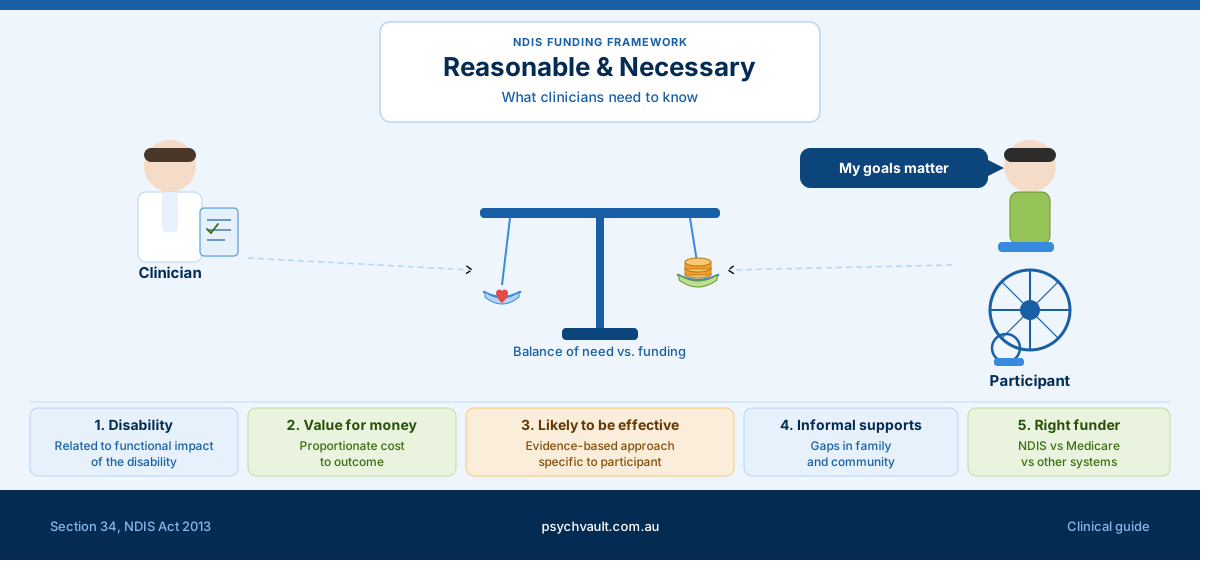
Reasonable and Necessary Under the NDIS: a visual guide for clinicians
NDIS ResourcesFeatured
19 April 2026 / 15 min read

Reasonable and Necessary Under the NDIS: What Clinicians Need to Know

Understand the NDIS reasonable and necessary criteria and learn how to write psychology reports that justify supports clearly for Australian clinicians.

reasonable and necessary NDISNDIS funding criteriapsychology NDIS report
By Ethan Smith
Read article
On this page
The short answerA pricing item is not permission to claimCurrent psychologist price limitsDirect psychology sessionsTelehealthNon-face-to-face workNon-face-to-face work is not ordinary administrationCase consultation and communication with other peopleReportsProvider travelCancellationsService agreements and advance cost disclosureProvisional psychologistsPlan management changes the payment pathway, not the clinical purposeA practical pre-invoice checkThe question to askPractical resources for your workflowSources and further information
Article details
Category: NDIS Resources
Published: 10 October 2026
Reading time: 14 min
NDIS psychologyNDIS billingnon-face-to-face supportsprovider travelcancellationsprovisional psychologists

Found this helpful?

Share