
A neurodiversity-affirming pillar guide to PDA, demand avoidance, the theoretical pillars behind autistic experience, and what visible behaviour does and does not tell us.
Educational information, not individual clinical, legal or regulatory advice. No independent review is identified for this article. Editorial policy and corrections.
Pathological Demand Avoidance (PDA) is one of the most contested, most misunderstood, and most clinically important concepts in autism today. It is named in research, used in formulation, recognised in some education systems, and largely absent from formal diagnostic manuals. Families use the term to describe something real. Clinicians use it cautiously, knowing the evidence base is still developing. Schools use it inconsistently, sometimes to support and sometimes to pathologise. And autistic adults increasingly use it to make sense of their own histories.
This post is a pillar guide to PDA and demand avoidance for clinicians, allied health professionals, educators, and informed parents and carers. It treats PDA not as a separate condition to be ruled in or out, but as a profile that becomes meaningful when we understand the theoretical pillars beneath it: autonomy, autistic cognition, communication mismatch, attention, executive function, sensory and interoceptive load, attachment, nervous-system threat, and the gap between visible behaviour and inner experience. If you are already thinking about how this changes your paperwork, the companion piece is what neuroaffirming templates actually need to do.
Demand avoidance cannot be understood properly if we only look at visible behaviour. Autism assessment, cognitive testing, school reports, and behavioural descriptions often privilege what can be observed from the outside. But many autistic people live with a major split between outer presentation and inner experience. The visible behaviour is data, but it is not the whole dataset.
This guide covers what PDA is and is not, the differential between PDA and conduct disorder, the wider variation across the autistic spectrum (hyperlexia, hyperempathy, hyperverbal presentations, synaesthesia, alexithymia), the major theoretical pillars (double empathy, monotropism, social motivation, executive function), the often-invisible categories of demand (cognitive, social, sensory, executive, proprioceptive, interoceptive, emotional, communicative), the limits of psychometric testing in capturing autistic experience, and what neurodiversity-affirming support looks like in practice.
Jump to a section:
Pathological Demand Avoidance was first described by British developmental psychologist Elizabeth Newson in the 1980s, working with children who presented with autistic features but whose defining clinical picture was an anxiety-driven, sometimes extreme avoidance of everyday demands. Newson and her team observed that these children often appeared more socially capable than their autistic peers, used social strategies fluently to escape demand (negotiation, distraction, role play, charm, escalation), and showed a level of resistance to even routine expectations that did not fit the standard autism profile of the time.
The term has stuck. The clinical concept has evolved. The framing has shifted. And the controversy has not gone away. The PDA Society describes PDA as a profile of autism, while also acknowledging that identification usually sits inside a broader autism formulation rather than a standalone diagnostic category.
Contemporary use of PDA — particularly in neurodiversity-affirming clinical practice — frames it less as a separate disorder and more as a profile within autism, characterised by:
Some clinicians prefer alternative terms: Persistent Drive for Autonomy, Pervasive Drive for Autonomy, Extreme Demand Avoidance. These reframings emphasise the underlying drive rather than the visible "avoidance", and they shift the framing from a deficit-laden pathology to a description of nervous-system architecture.
Whatever the label, the clinically important observation is this: in some autistic people, the experience of being asked, expected, or required to do something — even something they want to do — can trigger a threat response that overrides the capacity to engage with the task.
Every human being avoids demands sometimes. We procrastinate on the tax return. We delay the difficult conversation. We choose the easy task over the hard one. Avoidance, on its own, is not pathological. It is a normal response to demands that feel boring, painful, frightening, or low-priority.
What distinguishes the PDA profile from general demand avoidance is not the fact of avoidance, but its shape, intensity, and underlying mechanism.
General demand avoidance is typically:
PDA-profile avoidance is often:
A useful way to hold this: general demand avoidance is a behaviour. PDA is a nervous-system response.
This is one of the most consequential differential diagnoses in child and adolescent mental health, and one of the most often missed.
PDA can look, on the surface, like conduct disorder or oppositional defiant disorder. The young person refuses tasks. They negotiate aggressively. They escalate when pushed. They may swear, throw things, run, hit, lie, or destroy property. From the outside — in the principal's office, in the family GP's room, in the paediatric assessment — the picture can resemble the behavioural disorders described in DSM-5-TR.
The two presentations are fundamentally different, and the difference matters enormously for how the young person is treated, supported, and understood.
Conduct disorder, as defined in DSM-5-TR, involves a repetitive and persistent pattern of behaviour that violates the basic rights of others or major age-appropriate societal norms or rules. Diagnostic features include aggression to people and animals, destruction of property, deceitfulness or theft, and serious violations of rules. A specifier for "limited prosocial emotions" describes presentations with reduced empathy, callousness, and shallow affect.
Oppositional defiant disorder (ODD) describes a pattern of angry/irritable mood, argumentative/defiant behaviour, or vindictiveness, directed primarily at authority figures and resulting in significant impairment.
PDA-profile demand avoidance can produce behaviour that meets surface-level criteria for ODD, and in some cases conduct disorder. But the underlying mechanism, function, and clinical implications are different.
Key distinctions:
| Feature | Conduct disorder / ODD | PDA profile |
|---|---|---|
| Primary driver | Disregard for rules, authority, or rights of others; sometimes limited prosocial emotion | Anxiety-driven nervous-system threat response to perceived loss of autonomy |
| Function of behaviour | Intentional rule violation, dominance, personal gain, harm | Escape from demand, regulation of threat, preservation of autonomy |
| Social interest | Often reduced or instrumental | Often present, sometimes strong, but coexists with social pain |
| Empathy | May be reduced; callous-unemotional traits in some presentations | Often intact; many PDAers describe hyperempathy or moral intensity |
| Response to warmth and connection | May be limited | Often softens behaviour significantly when relational safety is high |
| Response to authority/structure | Pushes against authority; sometimes thrives on structure when contained | Authority and structure themselves can trigger threat response |
| Response to rewards/punishment | Often responsive (at least short-term) to behavioural systems | Often does not respond, or actively worsens, with reward/punishment systems |
| Internal experience | May or may not feel distressed by own behaviour | Often deeply distressed, ashamed, exhausted after episodes |
| Recovery pattern | Variable | Often a prolonged crash, withdrawal, shutdown after demand episodes |
The most clinically important distinction is anxiety versus intent. A young person with PDA is not refusing because they are choosing to disobey authority for personal benefit. They are refusing because their nervous system has classified the demand as a threat, and the behaviour that follows is a regulatory response, not a planned violation.
This matters because the standard response to conduct-disorder presentations (consequences, behavioural contracts, escalating discipline) is often actively harmful when applied to PDA. Punishment adds demand. Loss of privileges adds demand. Behaviour charts add demand. Each escalation increases threat, increases avoidance, and degrades trust. The result is a young person who looks more "behaviourally disordered" the more the system tries to contain them, and a clinical record that increasingly documents the iatrogenic harm rather than the underlying neurology.
When the formulation shifts — when the behaviour is understood as anxiety-driven rather than oppositional — the treatment shifts with it. Low-demand approaches, relational safety, autonomy support, and nervous-system regulation become the work. Behavioural contracts become contraindicated. The young person is not lazy, manipulative, or bad. They are flooded.
A useful test question for clinicians: if this young person had unlimited access to a safe space with no demands and a trusted adult, would they calm? If yes, you are likely looking at a regulatory profile, not a conduct presentation.
This differential is also relevant in adult presentations. Adults with PDA profiles are sometimes labelled as difficult, treatment-resistant, personality-disordered, or non-compliant in mental health, employment, and healthcare settings. The underlying nervous-system architecture is the same as the child's. The labels just become more stigmatising with age. For the workplace side of this problem, see neurodivergent clinicians navigating a profession not built for us.
PDA is not a formal diagnosis in DSM-5-TR or ICD-11. It does not appear as a discrete disorder, a specifier, or a subtype. This is a real constraint and worth being honest about.
What does appear:
The direction of travel in autism diagnosis is toward dimensional, contextual, and formulation-based understanding rather than narrow categorical diagnosis. This is consistent with broader movement in psychiatry toward transdiagnostic frameworks (HiTOP, RDoC), the growing acknowledgment of autistic heterogeneity, and the influence of neurodiversity-affirming clinical practice.
Whether or not PDA is named in the next DSM, the clinical reality it describes is unlikely to disappear. The question for clinicians is not "is PDA a real diagnosis" but "is this a useful formulation for this person, and does it lead to better support?"
Autism is often assessed through observable behaviour, developmental history, interview data, rating scales, and psychometric tools. These are useful, but they are not neutral windows into the person's inner world.
A person may appear socially capable while internally using enormous effort to script, mask, monitor facial expression, suppress stimming, tolerate sensory pain, decode indirect language, or manage shutdown. Camouflaging research describes how autistic people may hide autistic characteristics or present a more non-autistic social style, which can reduce the visibility of difficulty while increasing internal effort.
This matters for PDA and demand avoidance because a person may look like they are "choosing not to comply" when the internal reality is overload, loss of autonomy, threat response, processing delay, executive dysfunction, shame, or collapse in capacity. The behaviour visible to the school, the parent, or the clinician is the surface output of a system the observer cannot see.
The visible behaviour is data, but it is not the whole dataset.
This has consequences for assessment, formulation, and support. A young person who appears "fine" at school but melts down at home is not faking either presentation. They are running a masking system at school whose cost is paid at home. A young person who scores in the average range on cognitive testing may be doing so under conditions of extreme effort that do not reflect their day-to-day capacity. An adult who has held down a job for years may be functioning on systems of routine, scaffolding, and recovery that no test captures. The same inner/outer gap shows up in education systems, where what is visible to schools and assessors can diverge substantially from the person's internal experience.
The clinical task is not to choose between the inner and outer accounts. It is to hold both, and to take seriously the person's report of their own experience even when it does not match what is visible.
One tentative theoretical account asks why externally supplied rules may fail to become behaviourally organising. Predictive-processing models use salience and precision weighting as a formulation while keeping the limits of the evidence explicit.
Autism is not a uniform set of features. The "spectrum" framing is sometimes flattened into a line — more autistic to less autistic, more support to less support — but it is more accurately a constellation of cognitive, sensory, perceptual, communicative, and emotional differences that combine differently in different people.
Some of these differences are well-known. Many are less so, and they matter for formulation because they shape what demand, threat, support, and capacity look like for an individual.
Hyperlexia. Some autistic children show early, advanced reading or decoding skills, often before they have developed corresponding spoken language or comprehension. Hyperlexia can be missed because adults assume that a child who can read fluently must understand what they are reading. Decoding and comprehension are different cognitive processes. A hyperlexic child may read aloud at adult level while comprehending at a much younger level, or may understand technical text in a special-interest area while struggling with narrative texts about social situations. For PDA presentations, hyperlexia can also mean that written demands (instructions, signs, written social rules) carry significant weight, and that the child engages with text-based information very differently from spoken information.
Hyperempathy. The stereotype that autistic people lack empathy is one of the most damaging misconceptions in the field, and one of the most widely contradicted by lived experience. Many autistic people describe hyperempathy: an experience of feeling others' emotions intensely, sometimes overwhelmingly, sometimes to the point of needing to withdraw to protect themselves from emotional overload. Hyperempathy can coexist with difficulty expressing empathy in ways that non-autistic people recognise, and with difficulty knowing what to do with the empathic information. The empathy is there. The output channel can be different.
For PDA, hyperempathy matters because demand avoidance can sit alongside intense moral, social, and emotional sensitivity. A young person may refuse a task while simultaneously caring deeply about the person who asked. The refusal is not callousness. It is regulation.
Hyperverbal presentations. Some autistic young people — particularly those with PDA profiles — present as highly verbal, articulate, and socially fluent on the surface. They may use sophisticated vocabulary, negotiate with adult skill, and hold extended verbal exchanges that look much like conversation with neurotypical peers. This presentation often masks underlying difficulty: language used as a regulatory and social tool, not always as a window into shared understanding. Hyperverbal autistic young people are frequently missed in screening and assessment because their verbal output does not match the "non-verbal" or "delayed language" stereotypes.
(Note: the related term hyperlexia refers specifically to advanced reading; hyperverbal describes spoken-language fluency. Both are part of the wider profile.)
Synaesthesia. Synaesthesia — the involuntary cross-mapping of sensory experiences, such as seeing colours when hearing music, tasting words, or experiencing numbers in spatial positions — appears to be substantially more common in autistic populations than in the general population. For some autistic people, synaesthesia is a stable, often-pleasurable feature of their perceptual world. For others, it adds to sensory load and complicates the experience of being in busy environments. Either way, synaesthesia is part of the cognitive and perceptual variation across the spectrum, and it can shape how a person experiences demands — particularly demands involving multiple sensory channels at once.
Other features worth recognising include exceptional pattern recognition, deep special interests that organise cognition and identity, perfect or near-perfect autobiographical memory in some individuals, prosopagnosia (face blindness), exceptional spatial reasoning, and atypical pain perception (both hyposensitivity and hypersensitivity).
The point of listing these is not to romanticise autism, and not to imply that every autistic person has remarkable abilities. Most do not. The point is that the spectrum genuinely contains a wider range of cognitive, sensory, and perceptual variation than the deficit-focused diagnostic literature has historically captured, and that this variation matters when we are trying to understand why a particular demand feels the way it does to a particular person.
Alexithymia is the difficulty identifying, describing, and differentiating one's own emotional states. It is not unique to autism — it appears in a range of populations — but it co-occurs with autism at very high rates, with research estimates suggesting roughly half of autistic people experience clinically significant alexithymia.
Alexithymia is often confused with absence of emotion. It is not. Alexithymic people often feel emotion intensely; what they struggle with is the labelling, locating, and articulating of what they feel. The emotional signal is loud. The interpretive system is offline.
This connects directly to interoception: the sense of the internal state of the body. Interoception is how we know we are hungry, thirsty, tired, anxious, needing the bathroom, getting sick, sexually aroused, emotionally moved. It is the bodily substrate of emotional experience. Many autistic people have atypical interoception: signals may be muted, delayed, magnified, or scrambled. The connection between body state and emotional label may be weak.
When interoception is unreliable, emotional intelligence — in the sense it is usually measured — looks impaired. The person cannot easily name what they feel, predict their own reactions, or describe their emotional states to others. Standard emotional intelligence frameworks, developed largely on neurotypical populations, may misread this as a deficit in emotional capacity. It is not. It is a deficit in the interoceptive-linguistic interface — the bridge between body signal and verbal label.
For PDA and demand avoidance, this matters in several ways:
Alexithymia and atypical interoception also reframe a common clinical complaint about autistic young people: that they "don't know what they want" or "can't explain why they refused." Often, they genuinely cannot. The body knows. The interpretive system has not received the memo.
This is why emotional intelligence, in the autistic context, should not be measured against neurotypical norms. The emotional system is often deeply active. The translation layer is what differs. A neurodiversity-affirming approach to emotional support builds the translation layer — through interoceptive awareness work, body-based regulation, emotion-naming scaffolds, and patience with the slower processing speed — rather than concluding the person lacks emotional capacity.
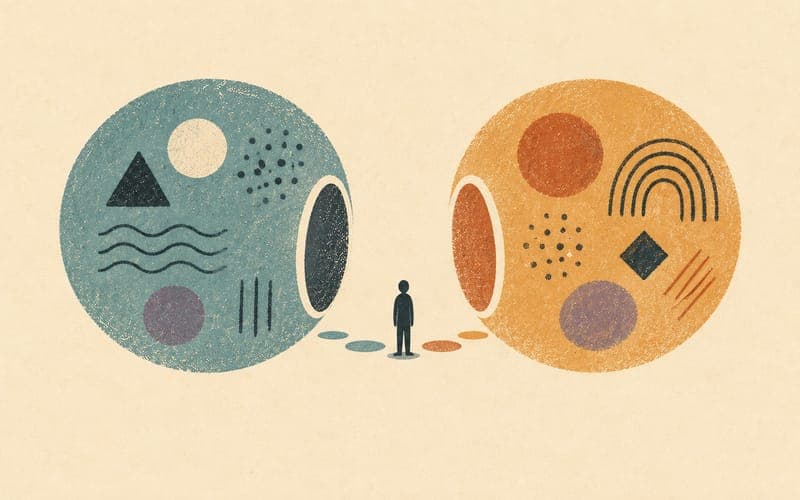
The double empathy problem, first articulated by Damian Milton in 2012, challenges the long-standing assumption that autistic social difficulty sits inside the autistic person alone.
Milton argued that communication breakdowns between autistic and non-autistic people often arise from a mutual mismatch between people with different ways of experiencing, interpreting, and expressing the world. Neither party fully understands the other. Both are misreading signals across neurotype. The autistic person is not the only one with reduced "theory of mind": the non-autistic person also has reduced understanding of the autistic person's experience, intentions, and communication style.
This is supported by a growing body of research. Studies of autistic-to-autistic communication show that autistic people often communicate effectively, share information accurately, and report rapport when interacting with other autistic people, even though the same individuals may struggle in autistic-to-non-autistic interactions. Crompton and colleagues' study on autistic peer-to-peer information transfer is one useful example. The "deficit" is not located in the autistic individual. It is located in the mismatch.
For PDA, the double empathy problem matters because many demands are social demands. They are shaped by tone, expectation, urgency, hierarchy, indirect rules, and hidden assumptions. A non-autistic adult may believe they are being clear, reasonable, and supportive. The autistic person may experience the same interaction as intrusive, confusing, controlling, or impossible to respond to.
The adult sees refusal. The autistic person experiences pressure, uncertainty, loss of control, or threat. Both are responding to different realities.
Practical implications:
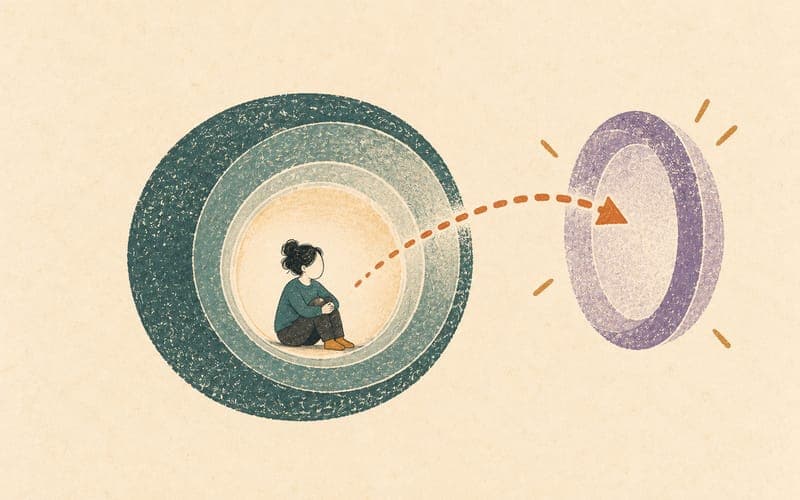
Monotropism is an attention-based theory of autism developed by Dinah Murray, Mike Lesser, and Wenn Lawson. The core claim is that autistic cognition involves a more focused, narrower distribution of attention — fewer "highly aroused interests" or "attention tunnels" active at any one time — compared with the more polytropic attention pattern typical of non-autistic cognition.
For monotropic cognition, being inside an attention tunnel is often deeply absorbing, regulating, and effective. Cognitive resources concentrate. The world outside the tunnel fades. Time can pass in flow. Many autistic people describe their special interests, deep work, and creative output as occurring inside this kind of focused state.
The other side of monotropism is that leaving an attention tunnel is costly. A demand from outside the tunnel — even a small, polite, well-intentioned one — may require the person to disengage from a coherent internal state, shift gears, reorient their nervous system, and engage with someone else's priority system.
From a monotropic lens, a demand is not just a request. It may be a forced attention shift. It can pull the person out of an internally coherent state and into someone else's priority system. For a PDAer, that shift may feel like loss of autonomy. For an autistic person more broadly, it may feel disorganising, painful, or impossible at that moment.
"Just pause that and do this" may sound simple from the outside. Internally, it can feel like being ripped out of one world and dropped into another.
This explains a clinical pattern that puzzles many non-autistic adults: an autistic young person who is deeply engaged in a self-chosen task may respond more strongly to interruption than to a wholly novel demand. The interruption is not minor. It is a forced exit from a regulating state. The same young person, approached at a transition point or invited into a new task with preparation and choice, may engage warmly.
Monotropism also reframes "rigidity" and "inflexibility." From inside a monotropic system, switching attention costs more energy than non-autistic cognition assumes. What looks like rigidity may be a sensible economy of cognitive resources: staying inside the tunnel because the cost of leaving is steep.
Social motivation theory, developed by Coralie Chevallier and colleagues, proposes that some social features of autism may be explained by reduced social orienting, reduced social reward, and reduced motivation to maintain social relationships. The theory has had significant influence on autism research over the last fifteen years.
It needs to be used carefully.
The reason for caution is that social motivation theory has often been simplified, in popular and clinical settings, into the claim that autistic people are not socially motivated, or that they do not want connection. This framing does not match the lived experience of most autistic people, including most autistic adults who have written publicly about their lives.
A more accurate framing: social motivation theory can help explain why social reward, approval, praise, or group belonging may not operate in the same way for every autistic person. But it should not be simplified into "autistic people do not want connection." Many autistic people deeply want connection, but not at the cost of sensory overwhelm, masking, social performance, coercion, or loss of autonomy.
For PDA, this is critical. Many behavioural strategies — in schools, in clinics, in homes — assume social approval is motivating. "Make the teacher happy", "earn a reward", "join the group", "be a good student". For some autistic or PDA-profile people, those strategies do not reduce demand. They add social pressure and increase threat. The reward becomes another demand. The praise becomes another performance.
This is part of why behavioural systems often work poorly with PDA. The motivation architecture they assume — that social approval and tangible reward will shift behaviour — does not map onto the autistic motivation system in the same way.

Executive functioning describes the family of cognitive skills involved in planning, initiation, inhibition, working memory, flexibility, monitoring, and task switching. It is the part of cognition that translates intent into action.
Research consistently identifies executive function differences in autistic populations, although the profile is heterogeneous, varies between performance-based and questionnaire-based measures, and is shaped by co-occurring conditions including ADHD.
For demand avoidance, executive function is one of the most important clinical lenses, and one of the most often missed.
A person may avoid a task not because they do not want to do it, but because they cannot find the entry point. They cannot sequence the steps. They cannot hold the steps in working memory once they start. They cannot transition into the task from where they are. They cannot estimate how long it will take. They cannot tolerate the uncertainty of starting something whose end-point they cannot yet see. They cannot shift attention from another task in progress.
Executive dysfunction can look like defiance when we only measure the outcome. The task is not done. The email is not answered. The child is not dressed. The assignment is not started. But the barrier may sit before behaviour, at the level of initiation, planning, switching, sequencing, uncertainty tolerance, or working memory.
"Won't start" is often "can't find the entry point."
This has direct implications for support. A young person who cannot initiate does not need motivation. They need scaffolding: visual structure, broken-down steps, body-doubling, a clear first action, removal of decision load. A young person who cannot transition does not need a faster prompt. They need a slower one, with warning, choice, and time. A young person who cannot hold steps in working memory does not need to be told the instructions more loudly. They need them written down, visible, externalised.
When executive function is the barrier, motivation-based interventions do not move the needle. Reward and consequence systems address the wrong layer.
One of the most useful shifts in understanding PDA is recognising that "demand" is not a single thing. It is a category that covers many different kinds of pressure, each of which can flood the nervous system in different ways, and each of which can be invisible to the person making the demand.
A neurodiversity-affirming formulation looks at the full demand landscape a person is operating within at any moment, not just the immediate request.
Cognitive demands. Anything that requires sustained attention, working memory, problem-solving, decision-making, or executive control. Reading a long document. Following multi-step instructions. Switching between tasks. Doing mental arithmetic in conversation. Following the plot of a film when tired. Cognitive load adds up across the day and does not reset quickly.
Social demands. Anything that requires social processing: making eye contact, reading facial expressions, modulating tone, masking, scripting responses, managing turn-taking, holding the social rules of a particular setting, anticipating other people's reactions. Social demands are often invisible to non-autistic people because they are automatic for them. For an autistic person, sustained social interaction can be one of the most depleting demand categories.
Sensory demands. Anything coming through the sensory channels: light, sound, smell, touch, taste, vestibular input, visual complexity, background noise, clothing texture, temperature, crowd density. Sensory demands accumulate. A fluorescent-lit, open-plan office is a sensory demand environment for many autistic people. So is a busy supermarket, a noisy classroom, a perfumed waiting room, or a building with constant low-frequency hum.
Executive demands. As above: initiation, sequencing, transition, working memory, prediction, uncertainty tolerance. Executive demands are often hidden inside other categories. "Get ready for school" is not one task. It is ten or fifteen sequenced executive operations.
Proprioceptive demands. Proprioception is the sense of where the body is in space and how its parts relate to each other. Many autistic people have atypical proprioception: under-registering body position, leading to clumsiness, postural difficulty, or a need for intense input (crashing, jumping, deep pressure) to feel located in the body. Proprioceptive demand includes holding still, sitting upright, fine motor tasks, handwriting, balancing on one foot, navigating a crowded space without bumping into people. What looks like fidgeting is often proprioceptive regulation.
Interoceptive demands. Interoception is the sense of the body's internal state. Interoceptive demand includes noticing hunger, thirst, fatigue, full bladder, rising heart rate, body temperature, emotional state. For autistic people with atypical interoception, these signals may be muted, delayed, or unreliable: meaning the body's internal needs accumulate without being noticed, until they become overwhelming.
Emotional demands. Anything requiring emotional regulation, emotional expression, emotional reading, or emotional containment of one's own state. Holding it together at school is an emotional demand. Maintaining a calm face in a meeting is an emotional demand. So is responding to someone else's distress, sitting through a tense family dinner, or absorbing a clinician's worry without showing it.
Communicative demands. Producing language, processing language, switching between communication modes, masking the way one naturally communicates. Many autistic people experience verbal communication itself as a high-cost activity, especially in unfamiliar contexts or when tired.
Existential and identity demands. Holding identity in a context that does not understand or accept the person. Performing neurotypicality. Tolerating ableism. Negotiating diagnosis disclosure. Existing in systems not designed for the person's neurology.
When we list the categories, it becomes clearer why an autistic young person can be flooded by what looks, to an outside observer, like a small request. The demand is not just the immediate question. It is everything in the cumulative demand landscape that the question lands inside.
The clinical implication: when a young person refuses, the question is not just "what was the immediate trigger?" The question is "what was the full demand load at the moment of the trigger?" Often the trigger is the final demand in a system that was already at capacity, and the seemingly disproportionate response is not disproportionate at all when the hidden demands are counted.

The "window of tolerance," a concept developed by Daniel Siegel, describes the zone of arousal in which a person can think, feel, and engage flexibly. Inside the window, the nervous system is regulated, prefrontal function is online, and behaviour is responsive rather than reactive. Outside the window — in hyperarousal (fight, flight, panic, anger) or hypoarousal (freeze, shutdown, dissociation, collapse) — flexible thinking goes offline. The system is in survival mode.
For PDA and demand avoidance, the window of tolerance is one of the most clinically useful frameworks. A demand that lands when the nervous system is inside the window may be received, processed, and responded to. The same demand, landing when the system is already outside the window, may trigger threat, refusal, escape, or collapse.
This reframes a great deal of "challenging behaviour" as nervous-system state. The behaviour is not the person's character. It is the person's state.
Polyvagal theory, developed by Stephen Porges, provides one popular framework for understanding the body's autonomic responses to safety and threat. The theory describes a hierarchy of states — ventral vagal (social engagement and safety), sympathetic (mobilisation, fight or flight), and dorsal vagal (immobilisation, shutdown, collapse) — and is widely used in trauma-informed and somatic clinical practice.
Polyvagal theory has been a useful clinical lens for many practitioners and clients. It maps well onto subjective experience, offers an accessible language for nervous-system states, and supports body-based regulation work. It is worth using with some honesty about its evidence base: the underlying neuroscientific claims, particularly about the ventral vagal complex's evolutionary origins and specific anatomical pathways, have been challenged in the academic neuroscience literature. The clinical utility of the framework as a metaphor and intervention scaffold is well-established. The fine-grained anatomical claims are more contested.
For practitioners working with PDA, the practical takeaway is this: nervous-system state is a real and important clinical variable; the window of tolerance is a useful organising concept; polyvagal language can be helpful with clients and families; and the framework should be held alongside other models of nervous-system regulation rather than treated as settled science.
What matters in the room is that demands land differently depending on state, that state can be supported, that recovery time after dysregulation is real, and that the nervous system can be co-regulated through relational safety, sensory support, and low-demand environments.
Attachment matters in PDA, though not always in the ways the early attachment literature would predict.
Many autistic young people, including those with PDA profiles, form deep, secure attachments to trusted adults. The attachment is often intense, often selective (one or two key figures rather than a broad network), and often expressed in ways that don't fit non-autistic templates for "secure attachment behaviour": less eye contact, less physical demonstrativeness, more proximity-without-interaction.
What complicates the picture is the interaction between attachment and autonomy. For a PDA-profile young person, the demand for relational closeness can itself become threatening if it constrains autonomy. The same parent the young person is deeply attached to can trigger demand-avoidance when they ask the wrong question at the wrong moment, in the wrong tone.
This produces a clinical pattern that confuses many adults: the young person clearly wants connection, clearly loves the parent, clearly seeks proximity, and also pushes the parent away, refuses requests, and escalates around the very person they are most attached to. The attachment is real. The autonomy threat is also real. Both are operating at once.
A relational frame that holds this is sometimes called autonomy-supportive attachment: closeness that does not require compliance, presence that does not require interaction, support that does not require acceptance. The work is to be available without being demanding, to remain warm without escalating, to stay regulated yourself when the young person is not.
This is exhausting work for parents and carers, and worth saying so plainly. It is also the work that helps.
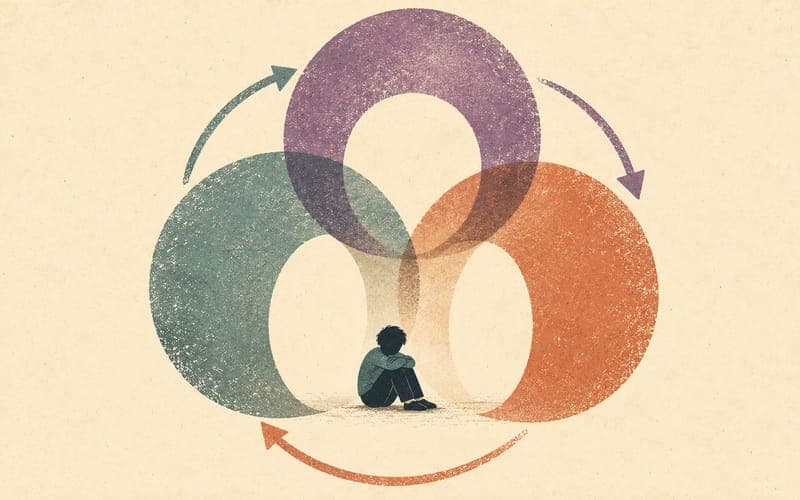
PDA does not occur in a vacuum. It occurs inside families, inside schools, inside healthcare and disability systems, and inside the broader social context. Each layer adds demand. Each layer can either amplify or dampen the underlying nervous-system reactivity.
A common pattern in PDA families is an escalation loop:
This pattern can run for years. It frequently produces a clinical record that documents the young person as increasingly "behaviourally disordered" without recognising the iatrogenic contribution of the system's response. When the pressure comes from disability funding, school evidence requests, or service access, the practical companion is the NDIS report template checklist, because the wording of functional impact matters.
Breaking the loop requires intervention at multiple layers, not just teaching the young person new skills, but supporting the family, advocating to the school, and sometimes naming the system response as part of the problem to be addressed.
For clinicians working with PDA families, this includes:

Tools such as the WISC, WAIS, and WIAT can be extremely useful. They can identify cognitive strengths and weaknesses, academic skills, working memory, processing speed, verbal reasoning, fluid reasoning, and achievement patterns. They are an important part of comprehensive assessment for many neurodivergent young people and adults. The same caution applies to progress notes and report writing: the record should describe functional reality, not just the behaviour visible in one appointment. For structure, see how to write psychology progress notes.
But they do not automatically explain how much effort, distress, masking, sensory load, or recovery cost was involved in producing the score.
The Wechsler family of assessments is designed to measure cognitive abilities and achievement-related skills under standardised conditions. These tools are not autism-specific measures of lived experience, sensory load, masking, monotropism, demand threat, attachment safety, or autonomy needs. They were never designed to be.
A standard score tells us how a person performed under standardised conditions, compared with a normative sample. It cannot, by itself, tell us whether the person was masking, dissociating, overcompensating, panicking internally, relying on perfectionism, suppressing movement, tolerating sensory pain, or crashing afterwards.
Psychometrics can measure performance. They do not always measure cost.
This is the inner/outer gap in its most concrete clinical form. Two children with identical Full Scale IQ scores may have wildly different lived experiences: one delivering the score effortlessly, one delivering it through hours of recovery time and masked distress. The score does not distinguish them. Only careful clinical interview and observation can.
Standardised tests compare the person's performance to a normative sample. That is useful, but the interpretive frame often assumes that test-taking conditions, instructions, motivation, speed demands, language style, and examiner interaction mean roughly the same thing across people. For autistic people, that assumption can be shaky.
Some examples of the gap:
This is why neurodiversity-affirming assessment should not only ask "what score did the person get?" It should ask:
The issue is not that psychometric tools are useless. The issue is that autism is not fully captured by visible performance under standardised conditions. For many autistic people, the clinically meaningful data includes effort, recovery time, sensory context, masking, autonomy, communication mismatch, and the gap between what can be done once and what can be sustained safely.
A score is a data point. A formulation is the story that data sits inside.
PDA is most often discussed in the context of children and young people, because that is where it has historically been identified and where the support needs are most immediate. But the underlying nervous-system architecture does not disappear in adulthood. It changes shape.
Childhood. Often the most visible period. School demands, parental demands, transitions, and developmental milestones create high demand load. Meltdowns, refusals, and shutdowns may be frequent. The family is often in crisis.
Adolescence. New demands enter: peer relationships, identity, sexuality, increasing academic complexity, executive demands of independence. Masking often increases through this period, particularly for autistic young women, non-binary, and gender-diverse young people. Internal cost increases. Mental health presentations (anxiety, depression, eating disorders, self-harm) often emerge or intensify.
Young adulthood. The transition into work, study, or independent living creates new demand structures. Some PDA-profile young adults find autonomy easier in self-directed environments and thrive after leaving school. Others struggle with the executive demands of independence and may experience prolonged extended adolescence, periods of withdrawal, or burnout.
Adulthood. Often invisible. Adults with PDA profiles may have built lives that minimise demand exposure: self-employment, solitary work, structured routines, partners who absorb administrative demand. Or they may be cycling through jobs, relationships, and services without understanding why nothing sticks. Diagnosis often comes late, sometimes after a child is assessed and the parent recognises themselves in the description.
Burnout. Autistic burnout — chronic exhaustion, loss of skills, increased sensory and social intolerance, sometimes meltdowns or shutdowns — is increasingly recognised as a distinct phenomenon across the lifespan. PDA-profile adults may experience particularly severe burnout cycles, often after periods of sustained masking and high demand load. Recovery requires significant demand reduction, often for extended periods.
Across all stages, the core architecture is recognisable: nervous-system reactivity to demand, autonomy as a regulating need, masking as a survival strategy with hidden cost, and the importance of low-demand, autonomy-supportive environments for sustainable functioning.

The phrase "low-demand parenting" or "low-demand approach" is sometimes misunderstood as permissive parenting, no boundaries, or letting the young person do whatever they want. It is none of those things.
Low-demand approaches are a recalibration of how demands are presented, not a removal of all expectations. The goal is to reduce the perceived threat of the demand to a level the nervous system can tolerate, so that engagement becomes possible.
Practical strategies that often help:
Use indirect language. Instead of "Put your shoes on", try "I wonder where your shoes are." Instead of "Do your homework", try "I'm going to make myself a cup of tea: I'll be back in a minute." The reduction in direct demand can be significant.
Offer choices. "Do you want to do it now or in five minutes?" "Would you prefer the blue one or the red one?" Choice restores a sense of autonomy without removing the underlying expectation.
Depersonalise the demand. "The bus is leaving at 8:15" lands differently from "You need to be ready by 8:15." The first is information. The second is a demand from a person.
Use humour, play, and novelty. PDA-profile young people often respond to novelty and humour when they cannot respond to direct request. Make it a race, a story, a character, a game. This is not childishness. It is regulation.
Reduce verbal density. Long explanations and reasoning often add demand. Short, neutral, low-emotion language usually lands better than detailed justification.
Allow declarative communication. Comment on what you see ("I see your shoes are by the door") without attaching expectation. Many PDA-profile young people respond to declarative information when they cannot respond to imperative request.
Offer fully exit-able choices. If the choice is not real, the young person will detect it. If the choice is real, the autonomy is real, and the regulation is real.
Co-regulate before you direct. A nervous system outside its window of tolerance cannot receive new demands. Time, space, and warm presence often restore capacity faster than instruction.
Reduce demand load, not just demand intensity. Cutting back on the number of things expected in a day is often more effective than refining the wording of individual demands.
Use visual structure and externalised executive function. Schedules, lists, timers, transition warnings, and visual instructions reduce the executive demand of holding the day in working memory.
Recognise recovery time as legitimate. After high-demand episodes, the nervous system needs time to return to baseline. Pushing back to demand too quickly produces another collapse.
These strategies are not magic. They do not work every time. They are not a script for compliance. But over time, applied consistently, they reduce the cumulative demand load and increase the proportion of time the nervous system spends inside its window of tolerance, which is the precondition for almost everything else (learning, connection, growth, capacity). If you are turning these principles into resources, read how to make psychoeducation handouts clinicians actually want to use.
A useful formulation for PDA-profile and demand avoidance presentations holds multiple layers at once. The core equation:
Demand avoidance = demand + perceived threat + capacity + context + communication mismatch + attention shift + executive load.
In practice, the questions to ask in formulation:
| Layer | What to ask |
|---|---|
| Demand | What is being asked, implied, expected, or internally required? What is the full demand landscape this lands inside? |
| Autonomy | Does this feel like choice, collaboration, or control? Is the person able to opt out without losing connection? |
| Nervous system | Is the person inside or outside their window of tolerance right now? What state were they in coming into this moment? |
| Attachment | Does this demand threaten connection, safety, or relational trust? Is the demand coming from a person whose attachment matters? |
| Monotropism | Does this require a painful attention shift or transition? Is the person being asked to leave a coherent internal state? |
| Double empathy | Are both people misreading each other's signals and intentions? Is the demand "clear" only from one perspective? |
| Executive function | Can the person initiate, plan, sequence, switch, and complete the task? Is the barrier before behaviour, in the cognitive scaffolding? |
| Sensory load | Is the environment already too loud, bright, social, or unpredictable? What sensory demands are already accumulating? |
| Interoception/proprioception | Is the person able to read their body? Are they hungry, tired, in pain, dysregulated, in a body they can't locate? |
| Alexithymia | Can the person name what they are feeling? Is the absence of words a real absence, or a translation-layer issue? |
| Communication | Is language being used as a tool of demand or as a tool of safety? Is there a less-demanding way to communicate this? |
| Cognitive profile | Are processing speed, working memory, language, motor, or achievement differences relevant? What does the psychometric data show, and what doesn't it show? |
| Systemic stress | Is pressure from school, family, work, or services being passed down as urgency? What part of the demand is the system's, not the person's? |
| Recovery | What does this person need to return to baseline? How much time, what kind of input, what kind of presence? |
This framework is not a checklist to complete in fifteen minutes. It is a way of holding the complexity of the presentation across multiple sessions, multiple sources of information, and multiple contexts.
The clinical art is in holding all the layers without flattening them into one explanation. The person is not just their autonomy needs, or their executive profile, or their nervous-system state. They are all of these, operating simultaneously, in a specific context, on a specific day.
Use this conceptual guide as the starting point, then move to the narrower question that matches the reader's task:
PDA and demand avoidance are not problems to be solved through compliance. They are nervous-system architectures to be understood, supported, and accommodated. The work is partly clinical — formulation, support planning, advocacy. It is partly relational — staying warm, staying regulated, staying available. It is partly systemic — pushing back on schools, services, and assumptions that pathologise difference. And it is partly internal — for clinicians, parents, and carers — the work of recognising that the visible behaviour is not the whole person, and that the whole person is worth meeting.
The visible behaviour is data. It is not the whole dataset. The rest is harder to see, but it is where the person lives.
For a concise visual handout that can support psychoeducation after an individual formulation, see the PDA psychoeducation handout on understanding demand avoidance. Review the listing and preview first to decide whether it suits the person, setting, and purpose of the conversation.
If you are developing PDA-affirming support resources, low-demand strategy guides, sensory accommodation tools, or neurodiversity-affirming assessment templates, PsychVault is being built as a place to share practical tools that clinicians can actually use. Browse the resource library, or create a store if you have your own worksheets, group plans, psychoeducation handouts, or clinical templates to share.
For visual psychoeducation on PDA, autism, and neurodiversity-affirming clinical work, I also share content on TikTok: @ethonsmoth.
Share your thoughts and experiences with this resource.
Sign in to leave a comment
Continue with the complete neurodiversity-affirming practice collection.
Find templates, handouts, and clinical tools created for use in real psychology and allied health work.
A clinical differential guide to PDA, oppositional defiant disorder, conduct disorder, anxiety-driven demand avoidance, intent, empathy, and contraindicated behavioural responses.
A practical guide to what Thriving Kids currently offers in WA, what is still rolling out and what remains unchanged for the NDIS until 2028.
Plan the move to high school for autistic, ADHD and other neurodivergent students using practical adjustments, IEP guidance and student voice.